Brand as a Meaning System: Why Narrative Is Not the Same as Messaging
Introduction — The Messaging Misunderstanding
Brand is often discussed in terms of messaging, storytelling, identity, and communication. These layers matter. They shape how an organization presents itself, explains its value, and seeks to make itself recognizable. But they do not fully explain how brand meaning is formed.
A brand is not only what an organization says, shows, or publishes. It is also what people come to understand through repeated signals, experiences, decisions, interactions, and context. Every touchpoint contributes to this process. A sentence on a website, a design choice, a pricing decision, a service experience, a delayed response, or a consistent pattern of behaviour can all shape how a brand is interpreted.
This is where brand messaging is often given too much responsibility. Messaging can express intended meaning, but it cannot guarantee that meaning will be received, believed, or sustained. A message may be clear and still fail to produce trust. A narrative may sound coherent yet still weaken if the surrounding experience says otherwise. What an organization intends to communicate is only one part of the system. What audiences interpret from repeated signals is where brand meaning begins to take shape.
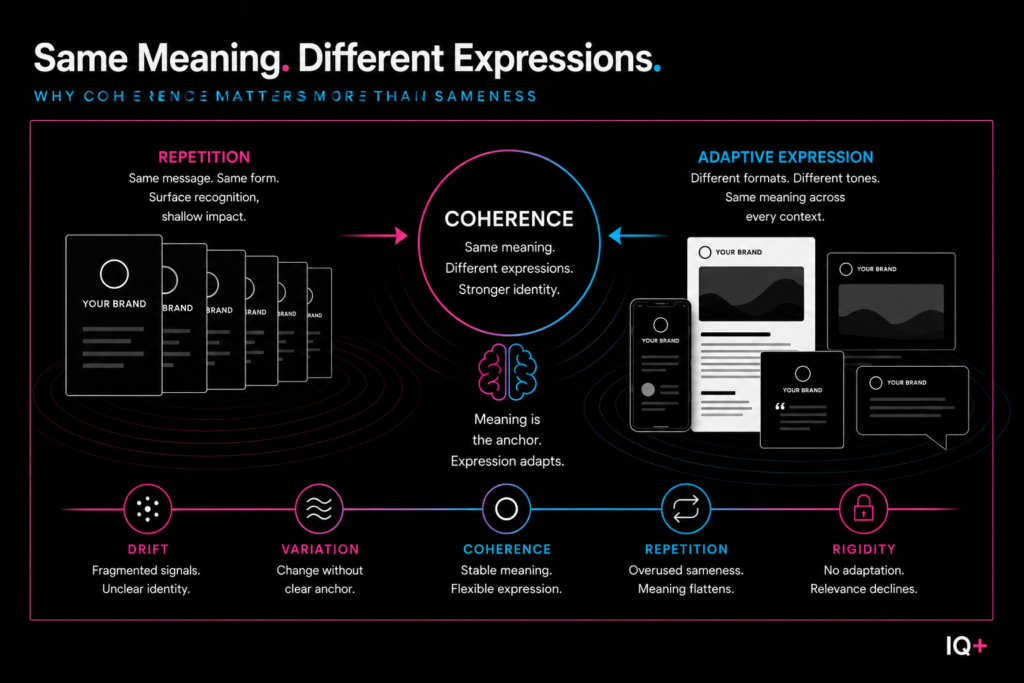
That meaning still has to remain coherent across changing contexts, which is why brand consistency cannot be reduced to repetition.
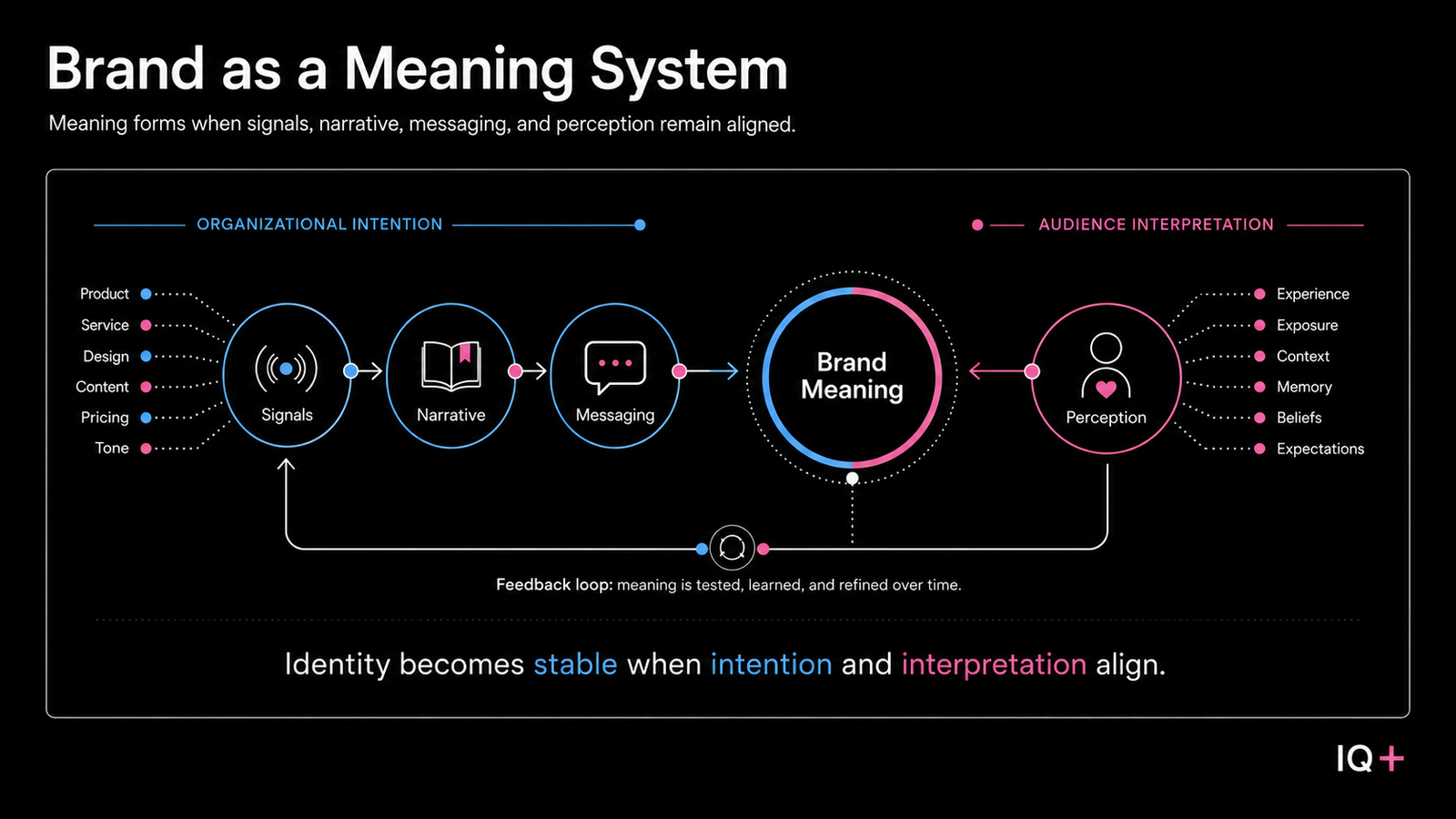
Narrative matters because it gives structure to that interpretation. It connects signals into a recognizable pattern and helps people understand what the brand represents over time. But narrative is not the same as messaging. Messaging communicates. Narrative organizes. Perception interprets. Brand identity becomes stable only when these layers remain aligned.
When brand is treated only as messaging, the focus stays on wording, claims, slogans, and communication outputs. When brand is treated as a meaning system, the focus shifts to the relationship between signals, context, experience, narrative, and perception. This distinction matters because brand meaning can weaken even when the messaging remains polished. It weakens when what is said, what is experienced, and what is interpreted begin to diverge.
To understand brand as a meaning system, the starting point is not the message itself. It is the signal environment from which meaning is formed.
Brand Begins as a Signal Environment
Before a brand becomes a narrative, it exists as a field of signals. These signals are not limited to the words an organization chooses. They appear through product experience, service behaviour, design choices, pricing, content, tone, responsiveness, consistency, and even silence. Each touchpoint contributes something to how the brand is read.
This matters because brand meaning rarely forms from a single message. A statement may introduce what an organization wants to be known for, but repeated signals determine whether that statement becomes credible. If a brand says it is careful but behaves carelessly, the message loses strength. If it says it is accessible but creates a difficult experience, the signal contradicts the claim. If it promises clarity but communicates in a confusing way, the contradiction becomes part of the brand experience.
Signals do not need to be dramatic to shape perception. A slow response can signal indifference. A consistent editorial standard can signal discipline. A pricing structure can signal exclusivity, accessibility, or complexity. A visual system can signal restraint, confidence, disorder, or imitation. A service interaction can confirm the stated identity or weaken it. Over time, these signals accumulate. They begin to form a pattern that audiences interpret before they accept any formal narrative.
Research on brand experience supports this broader view. Ongoing interactions with brand-related stimuli—such as visual references, products, services, and digital interfaces—continually shape how people think, feel, and behave toward a brand.
This is why brand touchpoints should not be treated as isolated outputs. A website, an email, a support exchange, a piece of content — each may seem separate in execution, but they are interpreted together. The audience does not experience brand meaning in departmental categories. It reads continuity, contradiction, absence, emphasis, and repetition across the full environment.
At this stage, the narrative has not yet organized the signals into a coherent identity. The signals exist first, and they are not all of the same kind. Some are intentional — a tagline, a design system, a positioning statement. Others are indirect: an operational delay, an inconsistency, the gap between a promise and its experience. Both kinds are available for interpretation, and neither can be erased by narrative. Brand, in this sense, begins before messaging is refined and before narrative is fully articulated — in whatever signal environment the organization has already created. If that environment is incoherent, the narrative will have to work against the evidence the organization is already producing.
Understanding brand as a signal environment changes the starting point of brand analysis. The first question is not only, “What is the brand saying?” It is also, “What is the brand causing people to interpret?” That distinction matters because brand meaning is shaped by the full pattern of signals, not by messaging alone.
Narrative Organizes Meaning
Signals alone do not create a stable brand identity. They create material for interpretation — noticed, perhaps, but not yet understood as part of a coherent whole.
Narrative is the structure that connects these signals into meaning. It gives direction to what the brand represents, why its choices matter, and how different expressions belong to the same identity. In this sense, narrative is not simply a story told outwardly. It is an organizing pattern that helps people interpret what they see, hear, and experience.
This distinction matters because brand narrative is often reduced to storytelling. Storytelling can be one way narrative is expressed, but narrative itself has a deeper function. It creates continuity. It helps separate isolated communication from recognizable meaning. It allows different signals to point toward the same underlying identity even when the format, channel, or context changes.
An organization’s outputs can look disconnected at the surface level — produced by different teams, at different times, for different purposes. Narrative is what allows them to be read as expressions of the same source, rather than as separate moments of communication.
This is why narrative cannot be treated as decoration added after messaging. If the narrative is weak, signals may compete with one another. The brand may appear polished but unclear, active but inconsistent, visible but difficult to understand. In that condition, brand meaning becomes unstable because audiences are left to assemble their own interpretation from scattered cues.
A coherent narrative does not require every message to sound identical. It requires the underlying meaning to remain recognizable. The wording can change. The format can change. The channel can change. But the interpretive pattern should remain stable enough for people to understand what the brand stands for, how it behaves, and why its presence is distinct.
Narrative, then, is not the message itself. It is the structure that allows messages, experiences, and signals to cohere. It does not replace the signal environment; it organizes it. This is where brand meaning begins to move from scattered impressions toward recognizable identity.
Messaging Is an Expression Layer
Messaging has an important role in brand formation. It gives language to the intended meaning. It helps an organization explain what it does, who it serves, what it values, and why its presence should matter. Without messaging, meaning may remain implicit, scattered, or difficult to communicate clearly.
But messaging is not the full system of brand meaning. It is an expression layer within that system. It translates meaning into words, claims, statements, descriptions, and headlines. It can make a brand easier to understand, but it cannot create coherence on its own if the surrounding signals do not support it.
This is where brand messaging is often overextended. An organization may refine its language, improve its positioning, or rewrite its core message. These changes can be useful, but they do not resolve deeper inconsistencies if the experience remains unclear, the behaviour contradicts the promise, or the narrative does not connect the signals into a stable pattern.
Good messaging can make the intended meaning visible. It can reduce confusion, sharpen recognition, and give audiences a clearer entry point into the brand. But its strength depends on the system behind it. If the brand experience supports the message, the language gains credibility. If the experience contradicts the message, the language becomes surface-level communication.
This does not make messaging superficial by default. It becomes superficial when it is asked to perform the work of the entire brand system. A message cannot replace consistency. It cannot compensate for unresolved contradictions. It cannot sustain trust when repeated signals yield different interpretations. It can only express the meaning that the broader system can support.
This is the distinction worth holding on to: messaging gives language to intended meaning, but it does not determine whether that meaning is believed. That depends on whether the message aligns with the signals, the experience, and the narrative surrounding it.
Brand messaging, then, should be evaluated not only on whether it sounds clear but also on whether it reflects a coherent system. A well-written message that aligns with experience strengthens brand meaning. A well-written message that does not align with experience only makes the gap more visible.
Perception Shapes Identity
Brand identity is often treated as something an organization defines for itself. It chooses its language, visual system, positioning, values, and preferred story. These choices matter because they establish intention. They clarify how the organization wants to be recognized and what meaning it wants to create.
But identity does not become stable through intention alone. It becomes stable when the intended meaning and the audience’s interpretation begin to align. A brand may define itself carefully, but that definition only gains strength when repeated signals make the meaning recognizable, believable, and consistent over time.
This is why perception is not separate from brand identity. It is part of the system through which identity is formed. People interpret what a brand says, but they also interpret what it does, how it behaves, what it emphasizes, and what it avoids. These interpretations shape whether the brand is seen as coherent, trustworthy, confused, generic, distant, or useful.
Perception does not mean the audience controls the brand entirely. A brand still needs boundaries: a stable meaning structure, a clear narrative, and enough consistency to prevent interpretation from scattering in every direction. But perception determines whether the intended identity is actually being received in a recognizable form.
This creates a useful tension. Brand identity must be internally structured but also externally interpretable. If the internal story is clear but the external experience does not support it, identity remains fragile. If the audience repeatedly receives signals that contradict the stated narrative, perception will begin to override intention.
Recognition depends on this alignment. A brand becomes recognizable when its signals repeatedly point toward the same underlying meaning. Trust depends on it as well. People are more likely to trust a brand when its messaging, behaviour, experience, and narrative do not require constant reconciliation. The fewer contradictions audiences have to resolve, the stronger the identity becomes.
That recognition can also shape how people search. When a familiar brand changes the name or domain through which users have learned to find it, the new expression may be technically valid without immediately carrying the same accumulated meaning. The WooCommerce move to Woo.com shows how brand continuity and navigational continuity can weaken at the same time.
Brand narrative, then, is not a secondary layer added after communication. It is the interpretive field where brand meaning is tested. Identity becomes meaningful only when the system produces signals that audiences can interpret with enough continuity. Without that continuity, the brand may still be visible, but visibility does not guarantee understanding.
To treat a brand as a meaning system is to accept that identity is maintained through interpretation, not declaration alone. What a brand says matters. What it causes people to understand matters more.
Where Meaning Breaks
Brand meaning weakens when the system stops producing coherent interpretation. The break is not always obvious at first. Messaging may still appear clear. Visual identity may still look consistent. Content may still be published regularly. But beneath the surface, the signals may begin to point in different directions.
One common break happens when signals contradict the stated narrative. A brand may describe itself as rigorous, personal, or responsive, but the surrounding experience may suggest otherwise. If behaviour repeatedly contradicts the claim, the claim loses authority — the audience need not reject the message outright. It simply begins to trust the signal more than the statement.
Another break occurs when messaging becomes repetitive rather than coherent. Repeating the same words can create familiarity, but familiarity is not the same as meaning. If messaging is repeated without adapting to context, audience state, or experience, it can become mechanical. The brand may sound consistent, but the consistency becomes shallow because it protects wording rather than meaning.
A further break occurs when visual, verbal, and experiential cues drift apart. The visual system may suggest restraint while the language suggests urgency. The messaging may promise simplicity, while the product experience creates friction. Each cue may function on its own, but together they produce interpretive noise.
The most serious break occurs when internal intent and external experience diverge — and the organization does not notice, or chooses not to act on what it does notice. A brand may believe its narrative is clear because it is clear internally, but internal clarity does not guarantee external interpretation. When the audience consistently reads the brand differently than the organization intends, and that gap goes unexamined, misalignment hardens over time. The brand is no longer shaped primarily by intention, but by the contradictions people are left to resolve on their own.
A brand does not lose meaning only because its message is unclear. It can lose meaning because the system around the message becomes inconsistent. The task is not only to improve communication, but to identify where the meaning system itself is producing contradiction, fragmentation, or drift.
Conclusion — Brand as a Maintained Meaning System
What changes once a brand is understood as a meaning system rather than a messaging exercise?
The starting question changes. Instead of asking whether the message is well written, the analysis asks whether it is supported by the signals the organization produces, the narrative that organizes them, and the perception that ultimately tests them. Messaging is no longer asked to carry the full weight of identity. It is asked to express a meaning that the rest of the system can actually sustain.
The relationship between intention and interpretation also changes. An organization can define what it wants its brand to mean, but that definition only becomes its identity once it is sustained by repeated experience. Brand meaning is not declared into existence. It is built from signals, organized by narrative, and confirmed — or contradicted — by perception over time.
This is the distinction worth carrying forward: messaging communicates, narrative organizes, and perception interprets. None of these layers can substitute for the others. A brand does not become coherent because its messaging is polished, its narrative is well told, or audiences overlook inconsistency. It becomes coherent when all three layers continue to point toward the same underlying meaning, encounter after encounter.
This is also where the work shifts from communication to maintenance. A meaning system is not fixed once and preserved automatically. It has to be examined for where signals are drifting, where narrative is failing to organize them, and where perception is beginning to diverge from intention — before the gap hardens into an identity the organization did not choose.
Brand Narrative, as a pillar, is built on this premise. It treats brand not as a fixed asset designed once, but as a system to be read: how meaning is built from signals, how narrative gives that meaning structure, how perception tests and shapes identity, and how misalignment — once it takes hold — is recognized and addressed. The articles that follow take up these questions under more specific conditions: how meaning is formed, how narrative holds together across channels and time, how brand signals are translated across contexts, and how meaning can be maintained when conditions change.
The premise underneath all of it stays the same. A brand is not only what an organization says. It is what its signals, narrative, and audience interpretation combine to produce over time.
If you enjoyed this analysis and would like to continue exploring these ideas, subscribe to receive new AnalytIQs+ essays and new publication updates by email.