Content Architecture: Why Publishing Is Not the Same as Structure
Content is often treated as a matter of production. A page is written. An article is published. A post is added to a schedule. A topic is selected, drafted, optimized, and released. From the outside, this can make content appear to be a sequence of outputs: individual pieces placed one after another over time.
But publishing is not the same as structure.
A body of content does not become coherent simply because more of it exists. Articles do not automatically support each other because they sit on the same website. Pages do not become strategically meaningful because they are indexed, categorized, or placed in a menu. A publishing schedule can create activity, but activity alone does not create architecture.
Content architecture is the system of relationships that determines how content is organized, connected, interpreted, maintained, and extended. It defines how individual pieces relate to one another, how readers move through a body of work, how search engines encounter relationships between pages, and how ideas accumulate meaning over time.
This distinction matters because content can grow without becoming stronger. A website may publish consistently while becoming harder to navigate. A publication may add articles while repeating the same ideas. A brand may create more pages while weakening the clarity of its message. A content archive may expand while losing its internal logic.
The issue is not the existence of content. The issue is whether the content has been structured into a system.
Content structure describes how information is organized and presented. It may refer to headings, sections, page layout, article format, or the arrangement of information within a single piece. Content architecture goes further. It defines the larger system of relationships across pages, topics, categories, internal links, content hubs, and maintenance practices.
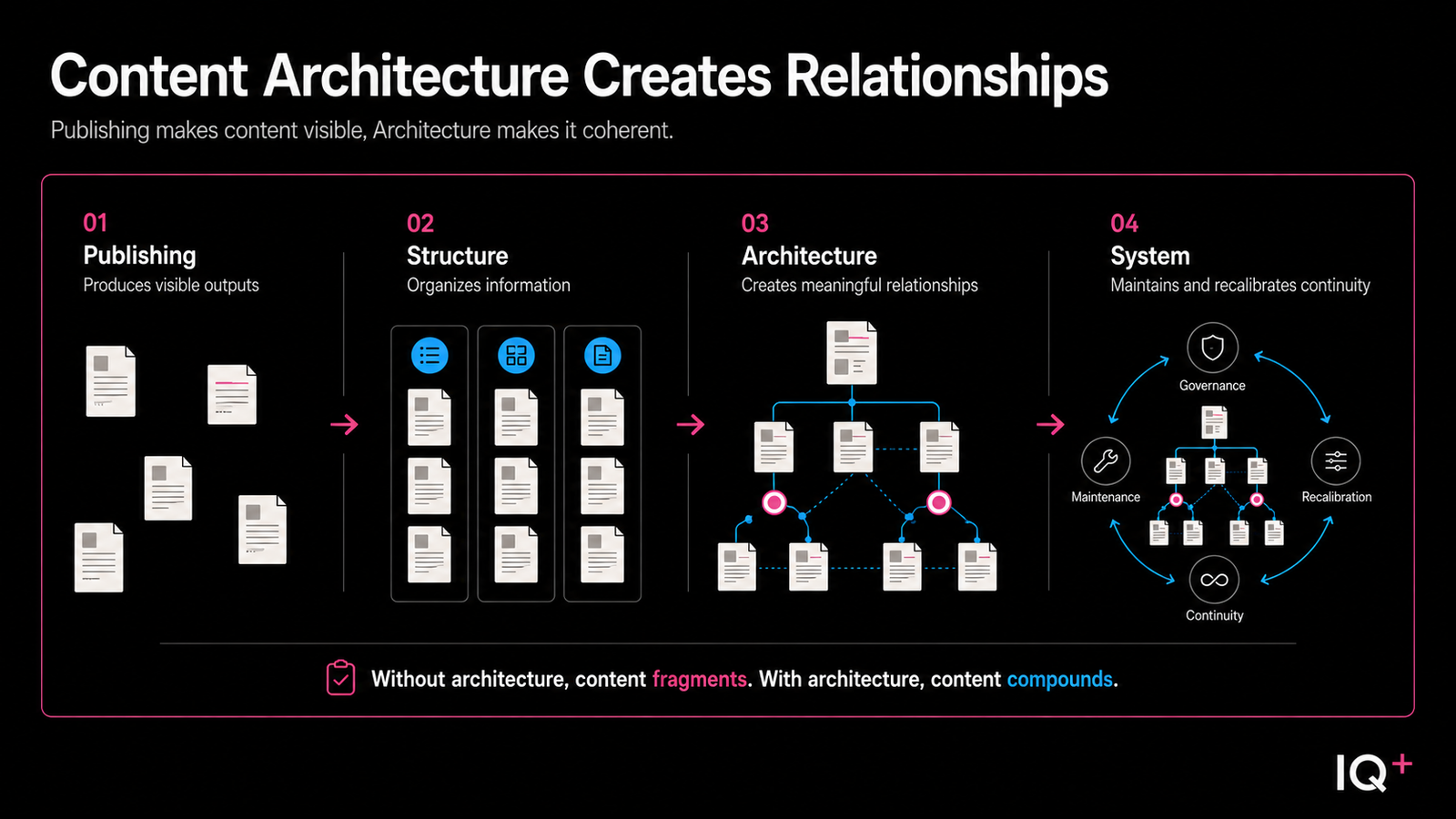
Publishing makes content visible. Architecture makes it coherent.
A content system becomes useful when individual pieces do not stand alone as disconnected outputs, but operate as part of a larger structure. Each page has a role. Each article extends, supports, clarifies, or deepens an existing argument. Internal links do more than pass authority; they guide interpretation. Categories do more than group posts; they shape how the publication is understood. Maintenance does more than update old material; it protects continuity.
Without architecture, content fragments. With architecture, content compounds.
Content Structure Is Not the Same as Content Architecture
The difference between content structure and content architecture is subtle, but important.
Content structure usually refers to the organization of information within a defined unit. An article has a structure. A page has a structure. A guide, landing page, report, or resource has a structure. This includes the sequence of sections, the hierarchy of headings, the placement of examples, the use of summaries, and the formatting of information for reading.
Structure helps a piece become readable. It gives shape to the content itself.
Content architecture operates at a wider level. It asks how that piece fits into a larger system. Why does this page exist? What does it connect to? What prior idea does it depend on? What future topic does it prepare? What should the reader understand before arriving here? What should they be able to explore after leaving?
This is where content becomes more than writing.
A single article may be well structured, but still poorly integrated. It may explain its topic clearly while having no meaningful relationship to the rest of the site. It may rank for a keyword, but fail to support the broader publication. It may attract a reader, but give that reader no clear path into the larger body of work.
In that case, the article has structure, but the content system lacks architecture.
Architecture creates relationships. It defines the role of each piece inside the whole. It turns a collection of pages into an organized body of work. It gives the reader pathways instead of isolated stops. It gives the publisher a structure for growth rather than an endless need for more topics.
This is why content architecture cannot be reduced to formatting, menus, or categories. Those elements matter, but they are expressions of a deeper logic. A category can organize content, but only if the category represents a meaningful conceptual relationship. A menu can guide navigation, but only if it reflects how the audience needs to understand the site. An internal link can connect pages, but only if the link clarifies why those pages belong together.
The structure of a page helps the reader understand the piece.
The architecture of a content system helps the reader understand the body of work.
Content Begins as an Architecture of Ideas
Content architecture begins before publication. It begins with the organization of ideas.
Before an article is drafted, a decision has already been made about what the article is supposed to do. It may introduce a foundational concept. It may develop a supporting argument. It may compare two related ideas. It may explain a mechanism. It may answer a narrow question. It may extend a previous essay or prepare a future one.
If that role is not clear, the article is likely to drift.
Many content systems weaken because they start with topics rather than relationships. A topic may be relevant, searchable, or timely, but relevance alone does not explain where it belongs. Without a larger architecture, topics accumulate as separate units. Over time, overlap increases. Similar ideas are repeated with slightly different wording. Internal links are added after the fact. Categories become storage containers. The publication grows, but its logic becomes harder to see.
A structured content system works differently. It does not ask only, “What should we publish next?” It asks, “What does this piece add to the system?”
That question changes the function of content planning.
A foundational article establishes the main argument. A supporting article develops one part of that argument. A comparison article clarifies a distinction. A diagnostic article shows where breakdowns occur. A framework article makes the underlying structure usable. A maintenance article revisits earlier material when context changes.
Each piece has a purpose beyond its own existence.
This does not mean every article must be rigidly planned months in advance. A content system still needs room for discovery, response, and recalibration. But flexibility is not the same as randomness. A strong architecture allows new ideas to enter without breaking coherence. It gives the publication enough structure to grow, and enough flexibility to evolve.
The point is not to control every future article. The point is to create a system where future articles can be placed, connected, and interpreted.
When content begins as an architecture of ideas, publishing becomes less reactive. The writer is not simply filling a schedule. The publication is not merely producing more pages. Each new piece has a relationship to the existing system and a reason for being added.
This is how content begins to accumulate value.
Pages Become Meaningful Through Relationships
A page is not meaningful only because of what it contains. It is also meaningful because of what it relates to.
A single article may define a concept, but its full value often depends on the surrounding structure. What does it link to? What links back to it? What category does it sit within? What larger argument does it support? What future reading path does it create? What does the reader understand differently because this page exists in relation to others?
These relationships shape interpretation.
For readers, relationships create orientation. They show where an idea belongs. They make it easier to move from one concept to another without being forced back to the homepage, search bar, or archive. They also help readers recognize continuity. Instead of encountering a series of unrelated articles, they begin to see a body of work with recurring questions, distinctions, and arguments.
For search engines, relationships also matter. Internal links, page hierarchy, topical proximity, and structural consistency can help clarify how content is organized. A page does not exist in isolation. It sits inside a discoverable system. The clearer the system is, the easier it becomes to understand the relationships between foundational pages, supporting articles, topic clusters, and related concepts.
Google’s official link guidance supports this aspect of content architecture. It explains that links help Google discover pages and assess their relevance, while descriptive anchor text helps both people and Google understand the relationship between connected content.
For the publisher, relationships create editorial discipline. They reveal where the system is strong, where it is thin, where ideas are being repeated, and where new articles would add genuine depth. A content system with clear relationships makes it easier to identify gaps. It also makes it easier to avoid unnecessary duplication.
This is where internal linking becomes more than an SEO tactic.
An internal link is often treated as a technical action: add a link from one page to another, use relevant anchor text, support crawl paths, and distribute authority. These functions matter. But internal linking also has an interpretive role. It tells the reader, “This idea connects to that idea.” It shows movement inside the publication’s logic.
A link can deepen an argument. It can point to a foundation. It can invite comparison. It can signal a sequence. It can show that a concept introduced in one article is developed more fully elsewhere.
When used structurally, internal links guide understanding.
The same is true of content hubs. A content hub can be useful because it gathers related material around a central topic. But a hub is not automatically architecture. It can become just another archive if it only collects links without clarifying relationships. A strong hub does more than display related content. It organizes a topic, identifies the central argument, separates subtopics, and gives the reader a path through the material.
A content hub is one expression of content architecture. It is not the whole system.
The larger system includes hierarchy, sequence, internal links, categories, topic boundaries, maintenance, and the relationship between foundational and supporting content. A hub may make part of that system visible, but the architecture is what determines whether the hub has meaning.
Pages become stronger when their relationships are intentional. Without those relationships, even useful content can remain isolated.
Publishing Is an Output Layer
Publishing matters. A content system cannot exist without visible content. Ideas need to be written, edited, formatted, released, indexed, and made available to readers.
But publishing is an output layer.
It is the point at which content becomes public. It is not the full system that gives content its role, relationship, or long-term value. A publishing schedule can support discipline, but it cannot replace architecture. Consistency of output is useful only when the output strengthens the system.
This distinction is easy to miss because publishing is visible. A new article can be counted. A calendar can be followed. A post can be shared. A URL can be inspected. A page can be indexed. These actions create evidence of activity.
Architecture is less visible. It is seen in the relationships between pieces, the clarity of pathways, the absence of unnecessary repetition, the stability of categories, the usefulness of internal links, and the ability of older content to remain connected to newer work.
A weak content system can still publish regularly. It can have many posts, clean formatting, clear titles, and active promotion. But if the pieces do not connect, the system does not compound. Each article must work alone. Each new piece starts again from zero. The archive grows, but the underlying structure remains thin.
This is the distinction explored more directly in The Content Workflow Trap, where visible organization and consistent activity can create the appearance of a system without the repeatability and continuity required to sustain one.
This creates a specific kind of content fatigue. The problem is not only that more content must be produced. The problem is that previous content does not carry enough structural value forward. Older pieces do not support newer ones. Foundational ideas are not being extended. Related topics are not being connected. Search data is not being interpreted within a clear system. Readers are not being guided through a larger body of work.
Publishing without architecture increases the burden of publishing.
A structured content system reduces that burden over time. It gives new articles somewhere to belong. It makes internal links easier to choose. It makes topic selection more disciplined. It helps the publisher decide whether an idea deserves a new article, belongs inside an existing article, or should be deferred until the system is ready for it.
This does not remove the work of writing. But it changes the nature of the work.
Instead of constantly producing isolated outputs, the writer builds relationships. Instead of chasing every possible topic, the publication develops a coherent field of analysis. Instead of measuring each page as a separate unit, performance can be interpreted through the structure that connects the pages.
Publishing creates visibility.
Architecture creates relationships.
Content Systems Connect Search, Data, and Brand
Content Systems is not separate from search, data, or brand. It is the organizing layer that allows those areas to work together.
Search depends on structure because discoverability is shaped by relationships. A page may target a keyword, but its search value is influenced by where it sits, what supports it, how it connects to related material, and whether the surrounding content clarifies its relevance. Search behaviour produces signals, but content architecture affects where those signals can attach.
If a site has no clear structure, search performance becomes harder to interpret. One article may receive impressions while another does not. A page may rank unexpectedly. A keyword may appear in Search Console without a clear context. Without architecture, these signals can look isolated. With architecture, they can be read as part of a system: which topic areas are visible, which relationships are being recognized, which pages are becoming entry points, and which areas need reinforcement.
Data also depends on structure. Metrics do not explain themselves. A pageview, impression, click, ranking movement, or engagement signal becomes more useful when the content system is clear. If the site has defined foundations, supporting articles, internal pathways, and topic boundaries, performance data can be interpreted against that structure.
A weak architecture produces ambiguous data. It becomes difficult to know whether a page is underperforming because the topic is weak, the article is unclear, the internal linking is insufficient, the search intent is misaligned, or the surrounding system is not sufficiently developed.
A clear architecture does not remove uncertainty, but it reduces noise.
Brand also depends on structure. Meaning weakens when content expression becomes scattered. A brand may have a clear narrative, but if its content system is fragmented, that narrative becomes harder to recognize. Different pages may emphasize different ideas. Articles may repeat language without developing meaning. The archive may contain useful material, but the larger identity may feel unclear.
Content architecture supports brand meaning by giving ideas continuity. It helps repeated concepts become recognizable rather than redundant. It allows a publication to return to core themes without merely saying the same thing again. It gives the audience a structured way to understand what the publication examines, how it thinks, and why its pieces belong together.
In this sense, content architecture is not only a technical or editorial concern. It is interpretive.
It affects how content is discovered, how performance is understood, and how meaning is maintained. It connects the visible surface of publishing to the deeper system underneath it.
Search shows how people arrive.
Data shows what can be observed.
Brand shapes what the work comes to mean.
Content architecture organizes the system in which those signals, observations, and meanings can accumulate.
Where Content Architecture Breaks
Content architecture breaks when growth becomes disconnected from structure.
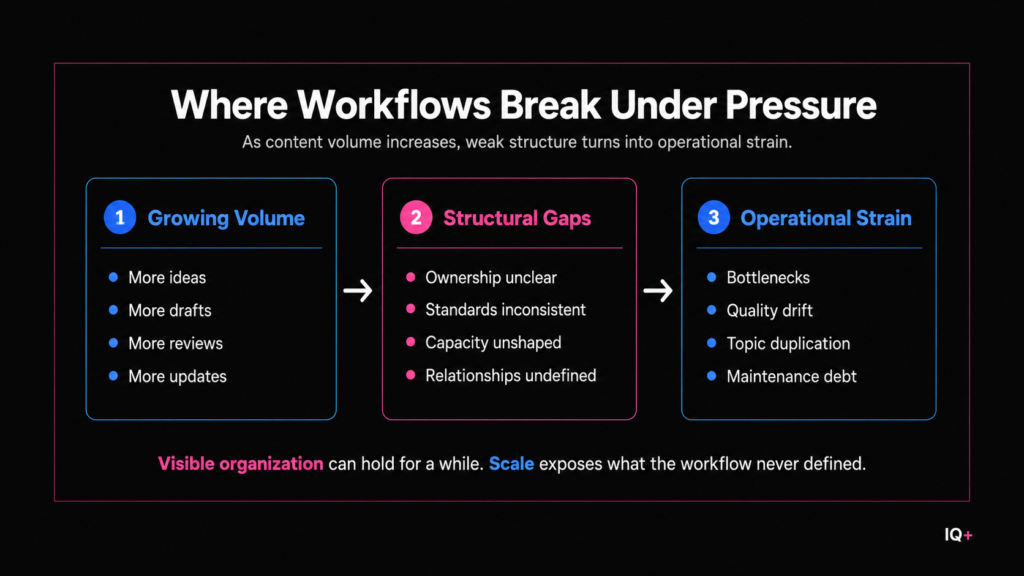
One breakdown occurs when content is produced without a clear role. Articles are written because they seem relevant, timely, or searchable — or because the schedule calls for something new — but their relationship to the wider system remains undefined. The result is not immediate failure.
Some articles may still perform. Some may still be useful. But over time, the publication becomes harder to manage, and a fixed cadence only accelerates the drift: if the schedule forces publication before an article has a clear role, the content system ends up carrying unnecessary weight. Consistency still matters, but only when cadence serves the system rather than substituting for editorial judgement. Over time, this creates maintenance debt — more pieces exist, but not all of them contribute to coherence.
Another breakdown occurs when topics overlap without intentional distinction. Overlap is not always a problem. Strong publications often return to the same themes from different angles. The issue is uncontrolled repetition. If several articles make the same argument without developing it further, the system begins to dilute itself. Readers encounter repetition instead of progression. Search engines encounter similar pages without clear differentiation. The writer begins to feel that the content runway is narrowing, even when many possible topics remain.
A related breakdown occurs when internal links are added mechanically rather than structurally. A link is not useful simply because two pages share a keyword. A structural link should clarify a relationship. It should help the reader understand why one piece matters to another. When links are added only for SEO, they can create pathways without interpretation. The system becomes connected on the surface, but not meaningfully organized.
Categories pose a similar problem when they become containers rather than interpretive pathways. A category should help define how content is grouped and understood. If categories are too broad, too vague, or too numerous, they become storage labels. They may organize the backend, but they do not help readers understand the publication’s logic.
The same failure appears with content hubs when they collect material without structuring it. A hub should organize a topic. It should help readers understand the central idea, the supporting subtopics, and the sequence of exploration. If a hub only gathers links, it may be useful as a directory, but it does not necessarily create architecture.
A slower-moving breakdown occurs when old content is left unmaintained. A content system changes as new articles are published. Older pieces may need updated links, revised framing, stronger references to newer material, or clearer placement inside the system. If older content is never revisited, the architecture begins to drift. The system may still contain useful pieces, but the relationships between them weaken.
The most consequential breakdown occurs when measurement focuses only on isolated page performance. A page may perform well while contributing little to the system. Another page may perform modestly while serving an important structural role. If performance is interpreted only at the page level, the value of architecture is missed. A foundational page, a bridge article, a glossary-style explanation, a comparison piece, and a content hub may all serve different functions. They should not be judged by the same narrow standard.
Content architecture breaks when these distinctions disappear.
Content as a Maintained Architecture
A content system is never finished.
Even a well-designed architecture needs maintenance because the system changes as it grows. New articles alter the meaning of older ones. New search data reveals unexpected entry points. New audience behaviour shows which pathways are being used and which are being ignored. New strategic priorities may require stronger topic boundaries or clearer internal links.
Maintenance is not a minor publishing task. It is what turns architecture into a working system.
Maintaining a content system preserves coherence over time. This includes updating older articles, refining internal links, clarifying categories, consolidating overlapping material, strengthening content hubs, and deciding when a new piece is necessary. It also includes knowing when not to publish.
A strong content system does not treat every idea as a new article. Some ideas belong inside existing pieces. Some belong in future sections. Some belong as internal links. Some are not yet ready because the supporting structure has not been built. Editorial restraint is part of content architecture.
This is especially important as a publication matures. Early content often establishes foundations. Later content develops distinctions, applications, examples, diagnostics, and refinements. Without maintenance, the relationship between these layers can become unclear. Foundational articles may no longer point to the most relevant supporting work. Supporting articles may introduce ideas that should be linked back to foundations. New categories may emerge. Old categories may need tightening.
The system must be recalibrated.
Recalibration protects the content from becoming an archive of past decisions. It allows the publication to evolve without losing its structure. It helps older content remain useful. It prevents new content from drifting away from the site’s central logic.
This is where content architecture becomes a long-term discipline.
It is not only about designing the first structure. It is about maintaining relationships as the body of work expands. It is about ensuring that new articles add depth rather than noise. It is about making sure the reader can still navigate the publication with clarity. It is about keeping the system interpretable for search, data, brand meaning, and editorial planning.
Architecture and system are related, but they are not the same thing. Architecture is the relationship structure an organization designs — the roles, sequences, and connections that give a body of work its logic. A system is what that architecture becomes once it is maintained: recalibrated as the publication grows, kept coherent as older and newer work accumulate. Architecture defines the relationships. A system preserves those relationships over time.
Publishing creates outputs.
Structure organizes information.
Architecture creates relationships.
Systems preserve continuity.
Content becomes strategically useful when these layers remain coherent over time. A publication does not become stronger by publishing more. It becomes stronger when each piece has a role, each relationship has a purpose, and the system can grow without losing its internal logic.
Content architecture is the difference between a collection of published material and a body of work that can compound.
That is the work of Content Systems: to organize, connect, maintain, and recalibrate content so that it remains coherent as it grows. With this foundation in place, the four lenses now work together: search shows how people arrive, data shows what can be observed, brand shapes what the work comes to mean, and Content Systems keeps the body of work connected, maintained, and coherent over time.
If you enjoyed this analysis and would like to continue exploring these ideas, subscribe to receive new AnalytIQs+ essays and new publication updates by email.