The Content Workflow Trap: Why “Feeling Organized” Isn’t the Same as Having a System
Introduction — The Feeling of Organization
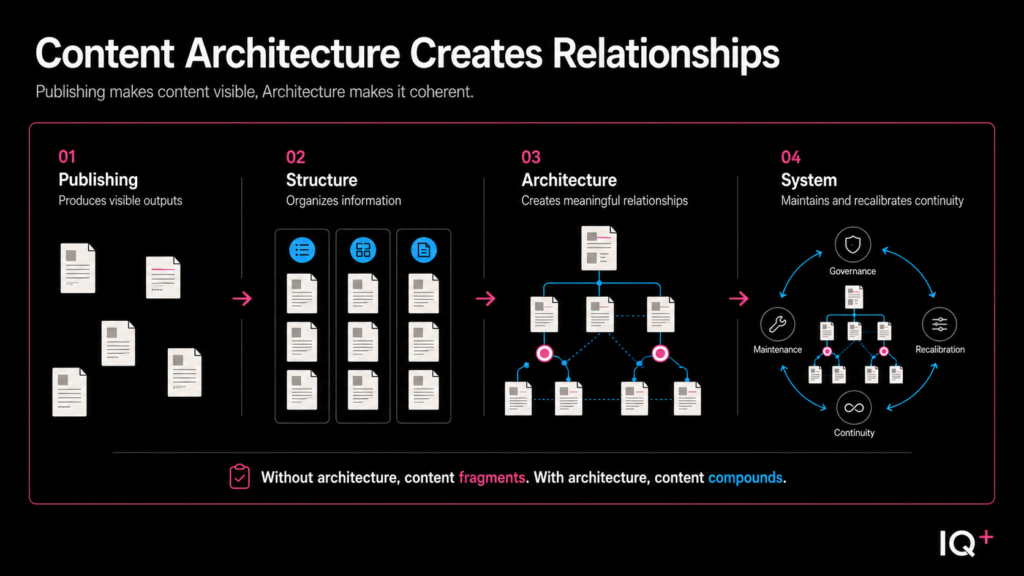
It is easy to mistake organization for structure.
I understand why this happens. A content calendar looks orderly. A project board makes the work visible. A checklist gives each task a place. A workflow shows what happens next. From the outside, the operation appears controlled because the moving parts have been named, arranged, and assigned.
That kind of organization matters.
Without it, content work quickly becomes reactive. Ideas sit in scattered notes. Drafts move without clear ownership. Publishing depends on memory. Updates get postponed. Internal links are forgotten. The same decisions are made repeatedly because no one has captured the logic behind them.
So the problem is not the content workflow itself.
The problem begins when a workflow is mistaken for the whole system.
A workflow can tell us what step comes next. It can show that an article moves from idea to outline, from draft to review, from review to publication, and from publication to update. That sequence is useful. It creates movement. It reduces some confusion. It makes the work easier to track.
But a workflow does not automatically explain how the operation holds together.
It does not necessarily define which ideas should enter the system. It does not decide what deserves priority. It does not clarify how standards are applied, how decisions are made, how capacity is protected, or how feedback changes the next cycle of work. It may show activity without showing the structure that governs that activity.
This is the workflow trap: the belief that visible organization is the same as having a system.
A content team, publication, or solo operator can feel organized while still depending on constant correction. The board is clean, but the decisions remain unclear. The calendar is full, but the priorities keep shifting. The checklist is followed, but quality still varies. The process exists, but the system underneath is thin.
That distinction matters because content work does not become stronger by becoming more visibly organized. It becomes stronger when the work is supported by structure.
A workflow organizes tasks.
A system governs execution.
The difference between the two is not cosmetic. It changes how content is planned, produced, reviewed, published, measured, and maintained. It changes whether growth creates clarity or pressure. It changes whether each new piece strengthens the body of work or simply adds more activity to manage.
Before a content operation can scale, it needs more than a workflow.
It needs a system strong enough to carry the work.
What a Workflow Actually Does
A content workflow is a sequence of activity.
It shows how work moves from one step to another. In content production, that sequence may begin with an idea, move into research, become an outline, develop into a draft, pass through review, reach publication, and later return for updates or maintenance.
IBM defines a workflow as a way of managing repetitive processes and tasks that occur in a particular order. This captures the workflow’s practical value: it organizes how work progresses, but does not by itself define the wider decision structure governing that work.
That sequence is useful because it gives the work a visible path.
Instead of treating each article, page, or campaign as a separate improvisation, the workflow creates repeatability. It reduces uncertainty about what happens next. It gives people a shared sense of movement. Even for a solo publisher, a workflow matters because it protects the work from becoming entirely dependent on mood, memory, or urgency.
A good workflow can answer practical questions.
Where does an idea go when it appears?
When does research happen?
When is the outline approved?
When is the draft reviewed?
What happens before publication?
What gets checked after the article goes live?
These questions matter. Without answers, execution becomes scattered.
But the important thing to notice is that a workflow mainly organizes movement. It does not necessarily explain judgement. It can show that a draft moves into review, but it may not define what the review is supposed to protect. It can show that an article moves into publication, but it may not define whether the article belongs in the system at all. It can show that links should be added, but it may not explain which relationships those links are meant to clarify.
This is where workflows can become misleading.
Because the steps are visible, the operation can feel more developed than it actually is. A content calendar may be full. A board may have columns. A checklist may be detailed. Each task may have a status, owner, and deadline. But visibility does not automatically create structural intelligence.
A workflow can help work move.
It cannot, by itself, decide whether the work is moving in the right way.
This is why workflow problems often return even after the process looks organized. The team follows the steps, but the same questions keep reappearing. The writer knows what to do next, but not how to make the right decision. The editor knows when to review, but not which standards should govern the review. The publisher knows when to release the piece, but not how it should connect to the larger body of work.
The workflow is doing its job.
It is organizing activity.
But if the system underneath is weak, the workflow will eventually carry problems it was never designed to solve.
What a System Actually Does
A system does more than move work forward.
It explains how the parts of the operation connect.
This is the key difference. A workflow shows sequence: first this, then that, then the next step. A system defines the structure that makes those steps meaningful. It connects inputs, priorities, roles, standards, decisions, outputs, feedback, and maintenance into a working whole.
That may sound abstract, so it helps to slow it down.
A content system decides what enters the pipeline. Not every idea deserves an article. Not every keyword deserves a page. Not every trend deserves a response. A system creates intake logic so the operation is not driven only by urgency, curiosity, or whatever appears useful in the moment.
It also defines how priorities are set.
One article may be important because it builds a foundation. Another may clarify a distinction. Another may support an existing page. Another may respond to search demand. Another may repair a gap in the content architecture. Without a system, those decisions can feel subjective. With a system, each piece is judged by the role it plays inside the larger body of work.
A system also protects standards.
This is where many workflows are too thin. A checklist may say “review draft,” but a system defines what the review is for. Is the argument clear? Is the internal linking serving interpretation, or was it added mechanically? Is the piece saying something the publication does not already have?
The workflow tells us that review happens.
The system tells us what review must protect.
A system also reduces dependency on memory. When the same decisions have to be remade every time, the operation becomes fragile. Quality depends on whether the right person remembers the right standard at the right moment. That may work for a while, especially at small scale, but it becomes harder to sustain as the body of work grows.
A strong system captures decision logic so it can be reused.
It does not remove judgement. It supports judgement. It gives the person doing the work a clearer structure for deciding what matters, what should change, what should stay stable, and what needs to be checked before the work moves forward.
This is why a system is not the same as a tool.
A project board can hold tasks. A calendar can hold dates. A template can hold a format. But the system is the logic that tells those tools what they are supposed to support.
The system answers deeper questions:
Why does this piece exist?
Where does it belong?
What standard should it meet?
What decision does it support?
What relationship does it create?
What happens after it is published?
How will feedback change the next cycle?
These questions are what turn activity into infrastructure.
A content workflow helps the work proceed.
A system helps the work hold together.
The Tool-Based Illusion of Control
Tools can make weak systems look stronger than they are.
This is one of the easiest traps to fall into because tools create visibility. Each one gives the process a shape people can see: a schedule, a status, a familiar layout, a completed step. These things are helpful, but they can also create the impression that the content operation is more structurally developed than it really is.
I do not think the problem is the tool itself.
A good tool can reduce confusion. It can centralize work. It can make responsibilities easier to see. It can prevent tasks from disappearing into private notes, scattered messages, or memory. Used properly, tools support the system.
But they do not create the system by themselves.
A project board can show that an article is “in progress,” but it cannot decide whether the article should exist. A content calendar can show that something is scheduled for Thursday, but it cannot decide whether the piece is ready. A template can organize sections, but it cannot ensure that the argument is strong. A checklist can confirm that steps were completed, but it cannot guarantee that the right judgement was applied.
This is where visibility becomes misleading.
When work is displayed clearly, it can feel controlled. The boxes are labelled. The tasks are assigned. The dates are visible. The process has a shape. But if the underlying decision logic is weak, the tool is only organizing the surface of the work.
It shows the operation.
It does not necessarily strengthen it.
This is why tool-based organization often breaks under pressure. At low volume, a board or calendar may seem like enough. The work moves. The system feels manageable. Problems can be corrected manually because there are still few enough pieces to remember, adjust, and repair.
But as volume increases, the weakness becomes harder to hide.
More ideas enter the pipeline. More drafts need review. More pages require internal links. More old content needs maintenance. More decisions compete for attention. At that point, the tool can keep showing the work clearly while the operation itself becomes harder to govern.
The board becomes full, but priorities remain unclear.
The calendar becomes active, but capacity is strained.
The checklist becomes longer, but quality still varies.
This is the illusion of control: believing that because the work is visible, the system is working.
A tool can help a strong system operate more smoothly. But when the system is weak, the tool often becomes a polished container for unresolved decisions. It manages activity without resolving the deeper questions of structure, priority, standards, ownership, and feedback.
The tool may show what is happening.
The system explains why it is happening, how it should happen, and what should change when the work no longer holds together.
Where Workflows Break Under Pressure
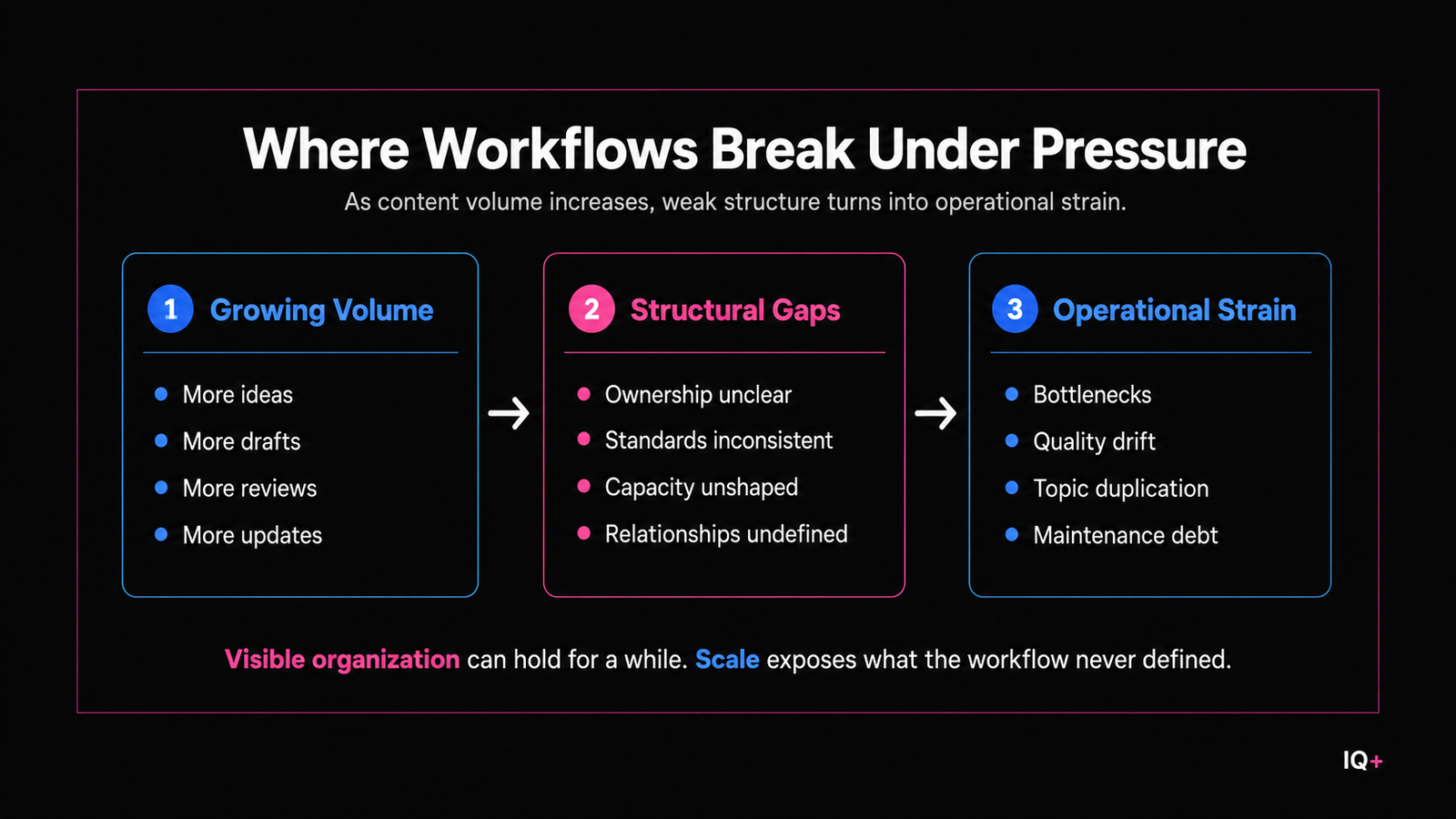
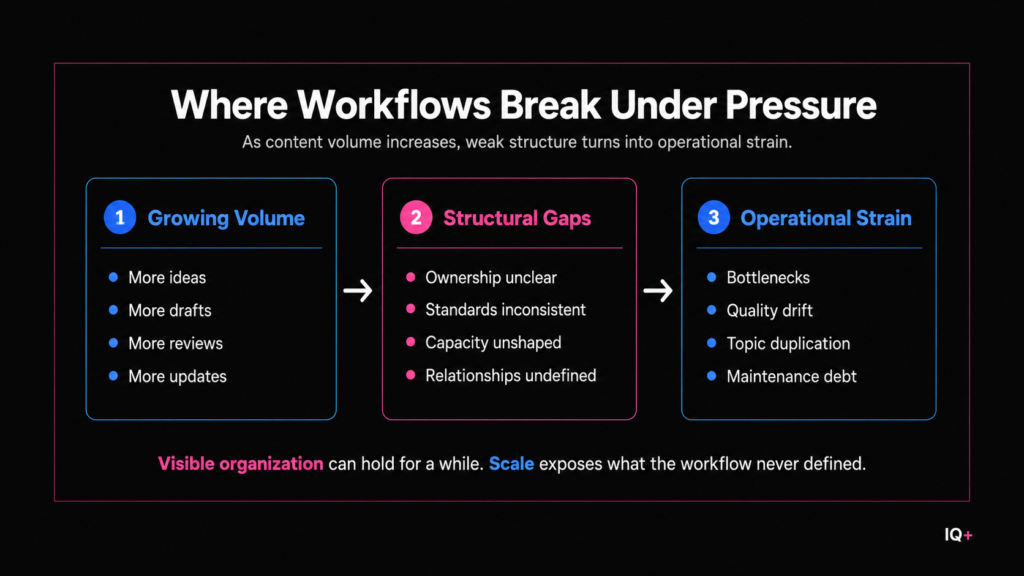
Workflows usually break when the work becomes more complex than the sequence can handle.
At first, the process may seem stable. Ideas are collected. Drafts are written. Reviews happen. Articles are published. Updates are noted for later. As long as the volume is low and the same person or small group remembers the logic behind the work, the workflow can feel sufficient.
But pressure reveals what the workflow does not define.
One common failure is unclear ownership. The workflow may show that a task has moved into review, but it may not define who is responsible for the final decision. One person checks the argument. Another checks formatting. Someone else reviews SEO. A fourth person notices that internal links are missing. The work moves forward, but responsibility remains scattered.
Another failure is inconsistent standards.
A workflow can say that every article should be reviewed before publication. But if the review standard is not clear, each review depends on the reviewer’s memory, preference, or available energy. One article may be checked for structure. Another may be checked mainly for grammar. Another may be reviewed for SEO. Another may pass because the deadline is close.
The step exists.
The standard does not.
This is how quality begins to drift even when the workflow is being followed.
Bottlenecks create another pressure point. A workflow may depend on one person to approve ideas, revise drafts, check links, prepare images, review SEO, and publish. That may work when output is slow. But as the publication grows, the same person becomes the constraint. The workflow still looks organized, but the system has not shaped capacity.
The process moves only as fast as the overloaded decision point allows.
Duplication is another sign that the workflow is carrying more than it can manage. Similar topics are proposed repeatedly. Articles overlap because the system has not defined topic boundaries clearly enough. Internal links are added after the fact because relationships were not considered during planning. Old decisions are reopened because there is no stable place where the reasoning is stored.
This is not only inefficient.
It weakens coherence.
The publication may continue producing content, but the body of work becomes harder to manage. Some pieces repeat earlier arguments. Some pieces do not connect to anything. Some pieces serve no clear structural role. The calendar stays active, but the architecture becomes heavier.
This is why workflow pressure is often misdiagnosed.
The obvious response is to add more organization: another column, another checklist, another template, another status label, another meeting, another review step. Sometimes that helps. But if the deeper problem is system weakness, more workflow detail can make the operation heavier without making it stronger.
The real question is not only, “What step is missing?”
The stronger question is, “What decision, standard, role, or relationship has not been defined?”
That question moves the diagnosis from workflow to system.
A workflow breaks under pressure when it is asked to carry judgement it was never designed to hold. It can organize movement, but it cannot replace the underlying logic that tells the operation what matters, what belongs, what should be protected, and when the work needs to change.
When that logic is missing, scale does not create efficiency.
It creates strain.
The Minimum Viable Content System
A content system does not need to be complicated before it becomes useful.
This is important because “system” can sound bigger than it needs to be. It can suggest a full operating model, a complex set of tools, a large team, or a level of documentation that only mature organizations can maintain.
But a system begins much earlier than that.
A minimum viable content system is simply the smallest structure that allows content work to move with clarity, consistency, and feedback. It does not need to solve every future problem. It needs to prevent the work from depending entirely on memory, mood, urgency, or repeated improvisation.
At minimum, the system needs an intake structure.
There has to be a way to decide which ideas enter the pipeline and which ones do not. Without intake logic, every idea competes for attention on the same level. A searchable topic, a personal observation, a timely trend, a strategic gap, and a maintenance need can all appear equally important. The system needs a way to ask: does this piece belong, what role would it play, and why now?
The second layer is prioritization.
A content operation cannot treat every piece as equally urgent. Some content builds foundations. Some content supports existing pages. Some content responds to search behaviour. Some content clarifies a distinction. Some content repairs a weakness in the architecture. Prioritization gives the work a logic beyond “what should we publish next?”
The third layer is production standards.
This is where the system defines what quality means before the draft is finished. The standard may include argument clarity, structure, evidence, tone, internal linking, search alignment, formatting, image direction, and update requirements. The point is not to make every piece identical. The point is to make every piece accountable to the same underlying expectations.
The fourth layer is review logic.
A review should not be a vague final check. It should protect specific things. Is the article saying something distinct? Does it belong to the right pillar? Does it repeat an earlier argument without adding depth? Does the structure carry the reader through the idea? Does the conclusion close the argument without opening a new one? Does the piece strengthen the publication’s body of work?
Without review logic, review becomes preference.
The fifth layer is publishing discipline.
Publishing is not only the moment a piece goes live. It includes the decisions that make the piece usable inside the system: category, title, URL, excerpt, schema, featured image, internal links, related reading, and post-publication checks. These details are easy to treat as administrative, but they shape how the piece enters the larger structure.
The sixth layer is measurement.
A system needs feedback, but not every number deserves the same attention. A new article may need to be monitored for indexing, impressions, query visibility, engagement, internal link behaviour, or position inside the archive. The point is not to obsess over early data. The point is to notice what the system is learning and what needs to be adjusted.
The seventh layer is maintenance.
Content does not stay fixed after publication. Older articles may need new internal links. A framework may need clearer placement. A supporting piece may need to be connected back to a foundation. A category may become too broad. A repeated topic may need consolidation. Maintenance keeps the system from becoming an archive of old decisions.
These layers do not require a large operation.
They require clarity.
A solo publisher can have a minimum viable content system. A small team can have one. A growing publication can have one. The question is not whether the system is complex. The question is whether it defines enough structure to keep the work coherent as it grows.
The minimum viable content system should answer a few basic questions:
What enters the pipeline?
What gets prioritized?
What standard does each piece need to meet?
How is the work reviewed?
How does the piece enter the publication?
What feedback will be watched?
When does the content need to be revisited?
Those questions are simple, but they change the nature of the work.
The operation is no longer only moving content from idea to publication. It is building a structure that can learn, adapt, and preserve coherence over time.
That is when a workflow begins to become a system.
Conclusion — Systems Before Scale
What changes when content work is treated as a system rather than a workflow?
The work becomes easier to understand because each piece has a role. Ideas are not accepted only because they seem interesting, searchable, or timely. They are evaluated by what they add to the larger structure. Some ideas become articles. Some become sections inside existing articles. Some become future topics. Some are held back because the system is not ready for them yet.
That restraint matters.
A content workflow can help a publication move faster, but speed is not always the right goal. If the system underneath is weak, more output can create more confusion. More articles can produce more overlap. More pages can create more maintenance. More movement can make the operation feel productive while the underlying structure becomes harder to manage.
This is why systems need to come before scale.
Scale does not only mean a larger team or a higher publishing volume. It can also mean more ideas, more internal links, more categories, more search data, more design decisions, more updates, and more relationships between pieces. Even a small publication becomes more complex as its body of work grows.
A content workflow can carry that complexity for a while.
But eventually, the question changes.
It is no longer enough to ask, “What happens next?”
The stronger question is, “What structure allows the work to keep making sense as it grows?”
That is the real function of a content system. It gives the work a way to hold together. It defines how ideas enter, how priorities are set, how standards are protected, how decisions are made, how feedback is interpreted, and how older content remains connected to newer work.
A good system does not remove judgement.
It makes judgement more durable.
It reduces the need to remake the same decisions from the beginning every time. It gives the writer, editor, team, or publication a clearer way to decide what matters, what belongs, what should change, and what should stay stable.
This is the difference between feeling organized and being structurally supported.
The workflow may show movement. The tool may show visibility. The calendar may show commitment. But the system is what determines whether the work can continue without losing coherence.
A workflow organizes tasks.
A system governs execution.
And before content can grow without becoming harder to manage, the system has to be strong enough to carry the growth.
If you enjoyed this analysis and would like to continue exploring these ideas, subscribe to receive new AnalytIQs+ essays and new publication updates by email.