Content Systems
How structure keeps meaning coherent as content grows.
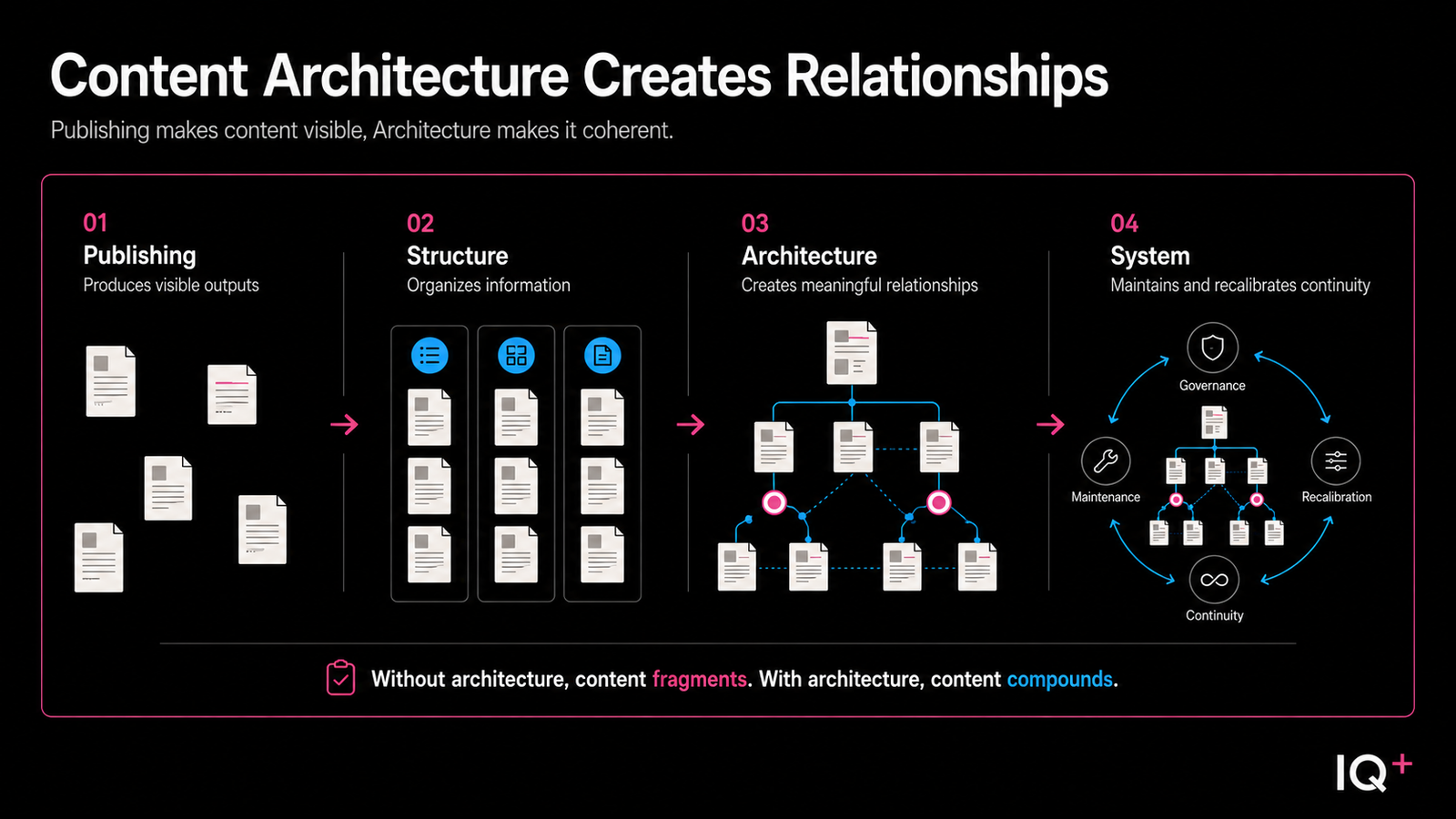
Content does not stay clear by volume alone. As pages, articles, and ideas accumulate, the structure around them determines whether understanding becomes clearer or more fragmented. This lens examines how content is organized, connected, and maintained so meaning remains coherent.
What Content Systems Examines
Content Systems examines how published work is structured so that ideas remain clear as the body of content grows.
It examines the role of each page, article, section, and link, and how these parts work together to guide understanding.
A piece of content may be well written on its own, but still weaken the system if its purpose is unclear, its placement is confusing, or its relationship to other content is not defined.
This lens focuses on the gap between individual content quality and overall content coherence.
The purpose is not to produce more material.
The purpose is to determine whether the content structure helps readers navigate ideas with clarity and continuity.
Google’s guidance on site organization supports this principle. A logical structure helps readers and search engines understand how individual pages relate to the rest of a website, making the larger body of content easier to navigate and interpret.
What Content Systems Help Identify
Content Systems helps show where content loses coherence as it expands.
A website or publication may have strong individual pages and articles, but still become difficult to understand if the parts are not clearly organized, connected, or sequenced.
This lens helps identify where:
- Pages or articles do not have a clear role
- Related ideas are disconnected from each other
- Repetition creates confusion instead of reinforcement
- Naming, categories, or navigation weaken understanding
- Content gaps make the reader’s path harder to follow
The value of this lens lies in testing whether the content works as a connected whole, not just as separate pieces.
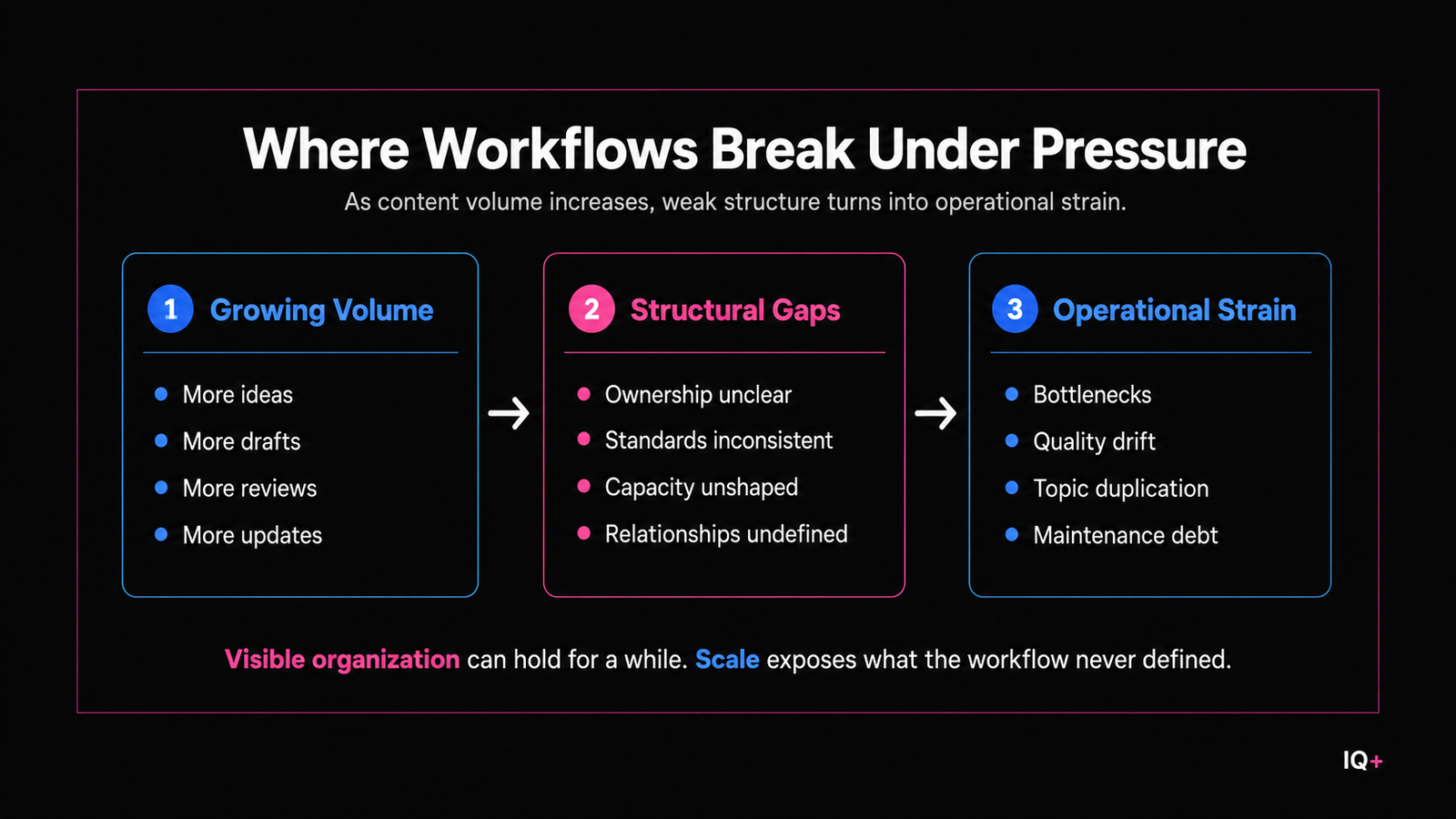
This distinction is examined more closely in The Content Workflow Trap, which shows how visible organization can create the appearance of a system without the repeatability, structure, and continuity that a real content system requires.
It helps examine whether the structure supports clarity, continuity, and useful movement across the system.
Where Content Systems Fits
Content Systems sits at the point where response becomes organized into structure.
After behaviour is observed, signals are interpreted, and meaning is framed, content becomes one of the main ways a digital system responds. It gives that response form through pages, articles, categories, links, and sequences.
Within AnalytIQs+, this lens helps examine how interpretation becomes organized material.
It shows how ideas are arranged, connected, and maintained so that the body of work remains understandable as it grows.
When this stage is weak, the system may still produce content, but the larger structure can become fragmented, repetitive, or difficult to follow.
Core Questions Behind This Lens
Content Systems is built around a simple concern:
How should content be structured so that understanding does not break as it grows?
From there, the lens explores questions such as:
- What role does each page, article, or section serve?
- How should content guide readers through ideas clearly?
- Where does repetition reinforce, and where does it become redundancy?
- How do naming, hierarchy, and links shape understanding?
- Where does content lose coherence through gaps, overlap, or weak sequencing?
These questions help keep the analysis tied to structure.
They shift the focus from content as output to content as an organized system that shapes understanding, continuity, and decision-making.
What You Will Find Here
This lens examines content systems as the point at which ideas are organized into a readable structure.
The writing looks at how pages, articles, sections, categories, and links work together to support understanding as the body of content grows.
It does not focus on producing more content, chasing formats, or publishing for volume.
It focuses on structure.
The purpose is to read content systems more carefully so that published work remains clear, connected, and useful across the larger body of content.
Related Analysis
Content Systems is one application of the broader AnalytIQs+ framework. It connects closely with Brand Narrative, where meaning and positioning require structure to become visible. It also links back to Search Behaviour, where published content produces signals that can be observed, interpreted, and recalibrated over time.
Stay Connected
Receive new AnalytIQs+ essays and publication updates directly by email.