Beyond Keywords: Why Intent Is the True Currency of Search
Search strategy often begins in the wrong place.
It begins with keywords — as if the phrase typed into a search engine contains the full meaning of the search. A keyword is collected, measured, grouped, and assigned to a page. From there, content is planned around matching the phrase, appearing for the query, and competing for visibility.
This process is useful, but incomplete.
A keyword shows what was typed. It does not explain why the search happened, what the user is trying to resolve, how much they already understand, what uncertainty they carry, or what kind of response would actually satisfy the need.
That deeper layer is search intent.
In SEO practice, intent is commonly reduced to four categories: informational, navigational, commercial, and transactional. These categories are useful for initial grouping, but classifying a query is not the same as understanding it. A label can organize the surface of the search without explaining the behaviour behind it.
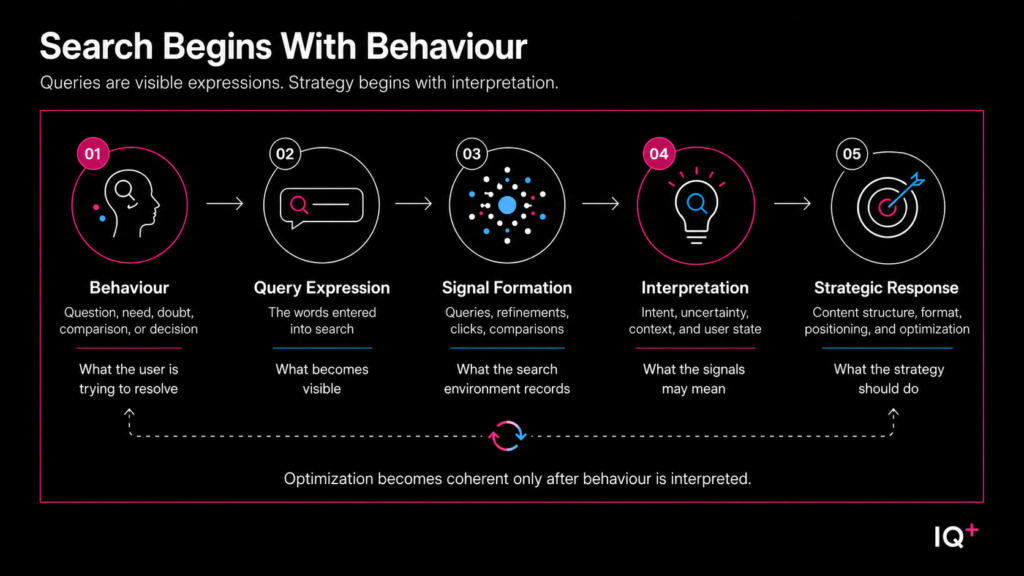
Search is a behavioural signal system. Queries are visible expressions of user states — they show demand, but they also show uncertainty, urgency, comparison, confusion, and direction. When strategy treats keywords as the primary input, it focuses on matching language. When strategy treats intent as the primary signal, it begins with interpretation. The question changes from “What keyword should this page target?” to “What is the user trying to understand, compare, decide, or resolve?”
The keyword is the surface artefact. Intent is the strategic currency.
Keywords Are Surface Artefacts
A keyword is observable. It can be collected, counted, compared, and placed into a research list. This makes it attractive as a planning unit — it gives structure to research and creates a visible connection between search demand and content production.
But visibility does not equal meaning.
A keyword is the language used at a particular moment in a search journey. It is the trace left behind by a user moving from one state to another: from confusion to clarity, from doubt to confidence, from awareness to comparison. The same phrase can carry different meanings depending on what produced the search.
A query for “best accounting software” may come from a small business owner comparing tools for the first time, an accountant seeking alternatives to recommend to clients, someone dissatisfied with their current software, or a student researching a market category. The keyword is identical. The intent is not.
This is why keyword data must be treated as evidence, not as conclusion. A keyword tells us that a topic is being searched. It may indicate volume, competition, and phrasing patterns. But it does not tell us the user’s decision stage, their level of knowledge, or the type of content that would actually satisfy the search.
When keywords are treated as complete meaning, content becomes mechanically aligned but strategically weak. It may use the right terms, answer the obvious question, and still fail to address the need that produced the search.
Keywords belong in the research process. They help identify demand and reveal how people express needs through language. But they should not be mistaken for intent itself. A keyword is the visible signal. Search intent is the interpretation of that signal.
Query Is Not Intent
A query is what the user enters. Intent is what the user is trying to achieve.
The distinction seems simple, but it is consistently missed in content planning. A query can be direct, vague, comparative, exploratory, or incomplete. It may express only part of the actual need.
Someone searching “mortgage renewal rates” may want more than current rates. They may be trying to understand whether to renew early, how to negotiate with their lender, or how to prepare for a higher payment. The query points to a topic; the intent sits behind it.
Someone searching “why did traffic drop” is rarely looking for a list of SEO issues. They are trying to diagnose whether the cause is seasonality, indexing, ranking loss, tracking problems, competitor movement, or content decay. The typed phrase is short. The interpretive space behind it is large.
Query language contains clues. Modifiers such as “best,” “how,” “why,” “examples,” “cost,” “reviews,” “vs,” and “alternative” each signal different user states — learning, comparison, urgency, decision readiness. But modifiers alone are not sufficient. Intent is inferred through the relationship between the query, the SERP, the surrounding questions, the result formats, and the user’s likely stage of understanding.
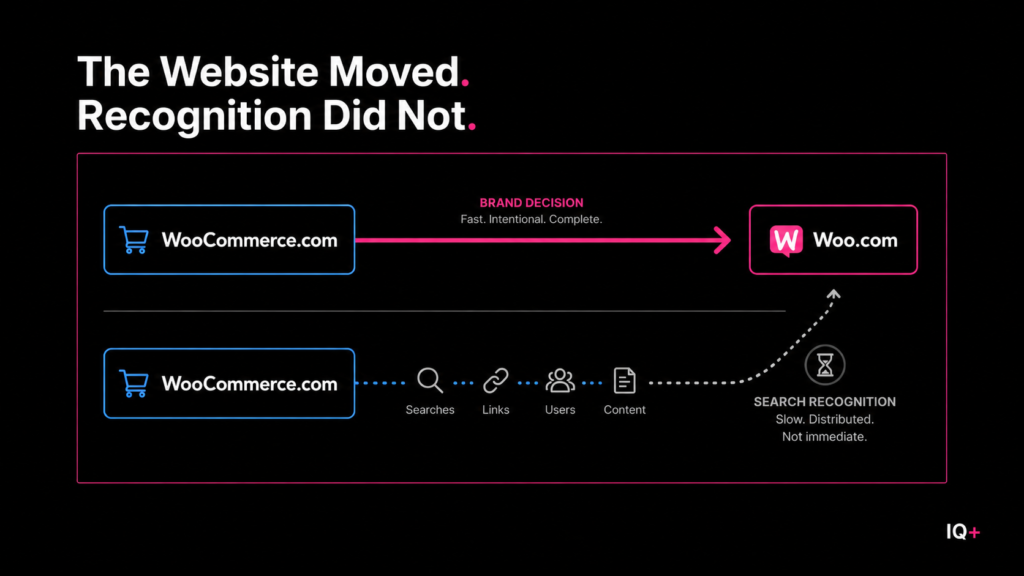
That interpretive context becomes especially important when a familiar brand changes the domain through which people have learned to find it. The WooCommerce move to Woo.com shows how branded search behaviour can remain attached to accumulated language, recognition, and navigational expectation even after the destination changes.
This is where search intent becomes more than a category.
The useful question is not only whether a query is informational or commercial. It is: what kind of information is needed, at what depth, with what level of trust, and for what next decision? A user searching “what is search intent” may need a definition. Another may need a framework for content planning. A third may be trying to understand why their content ranks but fails to convert. If every result offers the same basic definition, the deeper needs remain underserved.
That is the limitation of classification without interpretation. Keyword intent can group queries by broad goal, but strategy requires reading the query as part of a behavioural pattern.
When Keyword-Matched Content Still Fails
Content can match the keyword and still miss the search.
This failure is not a technical problem. It is an interpretive one. The page targets the phrase correctly — the search term appears in the right elements, the content is indexed, the tracking is in place — but the article was built around the wrong understanding of what the search was for. The mechanism is consistent: a page is planned around what the keyword appears to mean rather than what the query context reveals about the user’s actual need.
This produces several recurring failure patterns.
Depth mismatch. The article stays at the definition level when the user needs a practical framework, or assumes advanced knowledge when the user is still orienting. Neither version is wrong in isolation, but both can fail the search if the interpretive starting point was the keyword rather than the user state.
Angle mismatch. The page answers “what is this?” when the search was asking “why does this matter?” or “how do I apply this?” The keyword may support multiple angles, but content planning chose one without examining which the query context actually suggested.
Format mismatch. Some intents are served by a guide; others by a comparison, a diagnostic, or a step-by-step process. If the format does not match how the user needs to receive the information, the content can feel incomplete even when the information itself is accurate.
Stage mismatch. Content built for users ready to act encounters users who are still learning. Content that explains basics reaches users who are already comparing options. The page is not wrong about its subject — it is positioned at the wrong point in the decision path.
Assumption mismatch. The content assumes the user’s goal based on what the publisher wants them to do. The user is seeking clarity; the page redirects toward conversion. The user is comparing options; the page behaves as though the decision has already been made. This pattern is especially damaging because it can produce weak engagement on pages that appear analytically sound.
These failures are not resolved by adjusting keyword density or adding more terms. They are resolved by interpreting intent before deciding what the article should do.
In competitive SERPs, this distinction separates pages that exist from pages that work. Many articles target the same keyword, explain the same concept, and follow similar structures. The advantage comes from a sharper understanding of what the current result set is not resolving. A strong article asks not only “What are the top-ranking pages doing?” but “What user need are these pages not fully satisfying?” That question moves content strategy from imitation to interpretation.
Google’s people-first content guidance reflects the same principle. It asks whether readers leave feeling they have learned enough to achieve their goal and warns against content that sends them back to search for better information.
Intent Mapping Before Content Planning
Intent mapping is the process of translating search signals into content decisions. It should happen before drafting, not at the optimization stage. If intent is considered only after the article has been written, it becomes a surface adjustment applied to a structure that may already be misaligned.
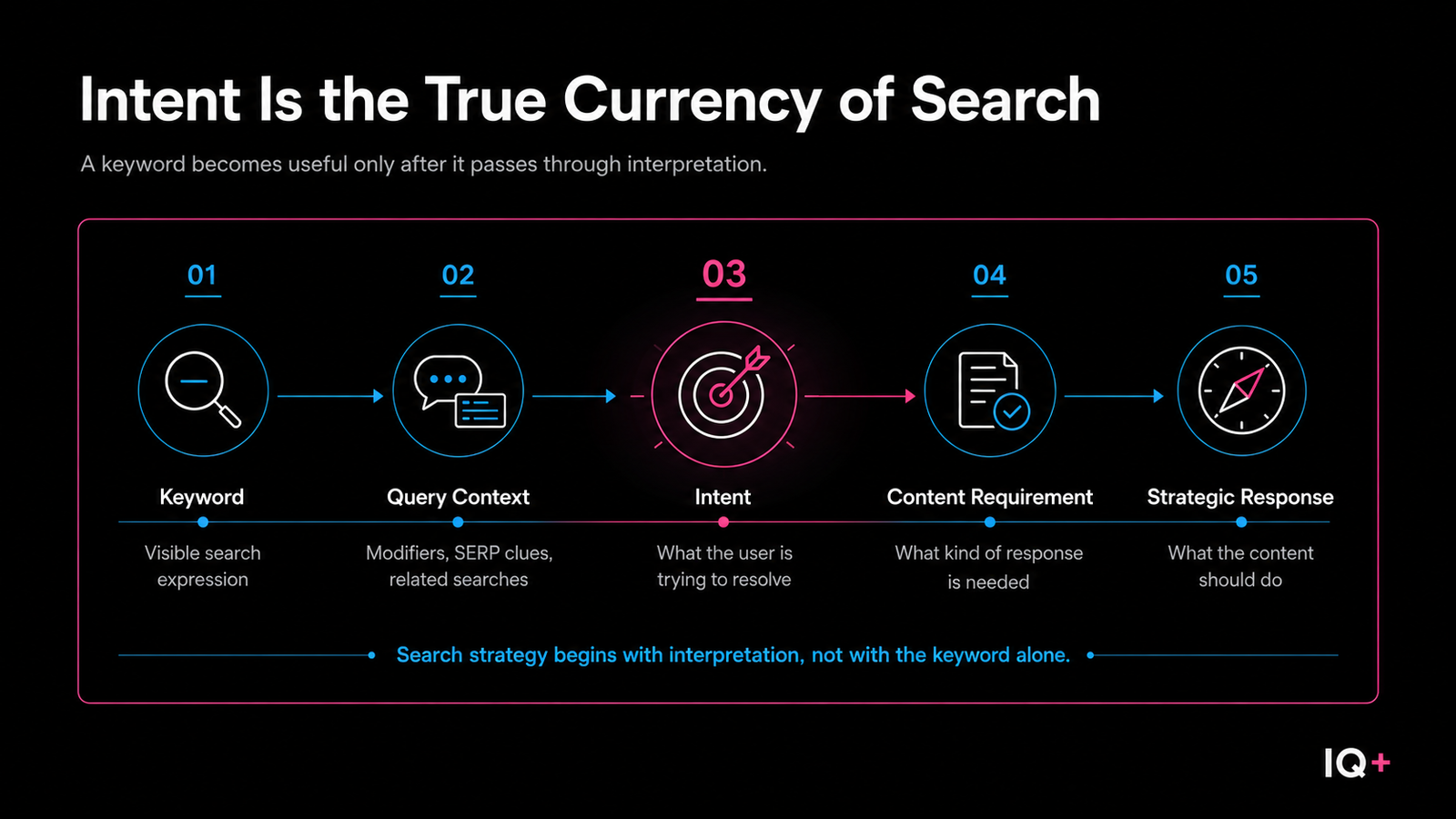
The process works in five layers.
The first is the keyword: the visible search expression, the initial topic and demand signal.
The second is the query context: modifiers, phrasing, related searches, People Also Ask results, SERP features, and the types of results being surfaced — together, these show how the search environment is interpreting the user’s need.
The third is the user state: inferred, not directly observed. Is the user confused, comparing, validating, diagnosing, or ready to act? What level of knowledge do they appear to have?
The fourth is the content requirement: what the page must provide — definition, explanation, comparison, diagnostic framework, or decision support.
The fifth is the strategic response: the actual function of the content. Is the article meant to clarify a concept, challenge a misconception, organize a decision, or expose a gap in how the topic is normally discussed?
Intent Mapping Card
A keyword becomes useful only after it passes through interpretation.
01
Keyword
What visible search expression appears?
Identifies the typed phrase, topic, and demand signal.
02
Query Context
What surrounds the query?
Reads modifiers, SERP patterns, related searches, and result types.
03
Intent
What is the user trying to resolve?
Interprets uncertainty, stage, urgency, knowledge level, and need.
04
Content Requirement
What kind of response is needed?
Defines the format, depth, angle, and structure the page must provide.
05
Strategic Response
What should the content do?
Turns interpretation into a clear content decision: clarify, compare, diagnose, challenge, or guide.
This sequence prevents articles from being planned around the keyword alone. It also addresses a common planning problem: using the same article structure for every search in the same category. Not every informational query needs a “what, why, how” article. Some need a distinction. Some need a diagnostic. Some need a framework. Some need to start with a better question.
Search intent is not a category to assign. It is a signal to interpret.
From Keyword Lists to Intent Architecture
Traditional keyword research produces lists — grouped by volume, difficulty, topic, or semantic similarity. This is useful as an inventory, but it remains too flat to generate a coherent content plan.
Search intent architecture goes further. It organizes keywords according to the underlying needs they represent and the relationship between those needs. Instead of asking which phrases belong together, it asks how different searches reflect different stages of understanding.
A cluster built around “search intent” might include: what is search intent; search intent types; keyword intent; search intent examples; how to identify search intent; search intent optimization; commercial search intent. A keyword list groups all of these under one topic. Intent architecture separates them by function.
Some searches seek definition. Some seek classification. Some seek application. Some seek diagnostic methods. Some seek optimization tactics. That difference matters because a single article cannot satisfy all these layers equally — and attempting to do so usually satisfies none of them well.
A publication that understands this builds a progression rather than a pile. A foundational article explains the concept. A later article diagnoses why keyword-matched content fails. Another examines how to map intent across a content system. The topic is the same. The intent layers are different. Each article has a specific role in the larger structure.
This is how a publication avoids redundancy without narrowing its range.
The result is a content hierarchy that mirrors how understanding develops:
Keywords help locate demand. Queries reveal expression. SERPs expose patterns. Intent gives direction. Interpretation creates strategy.
Without that hierarchy, content planning becomes reactive. It follows phrases without understanding behaviour. It copies SERP structures without questioning whether those structures satisfy the user. It produces pages because terms exist, not because the system needs a meaningful response.
Intent architecture turns keyword research from a collection exercise into a decision process.
Conclusion — Intent as the Real Search Currency
Keywords remain useful. They show how demand is expressed, where visibility may be possible, and how people phrase their needs at different stages of a search journey. They belong in the evidence layer of search strategy.
But the strategic value of a keyword is determined by the search intent behind it. The same phrase, in a different context, at a different stage of understanding, serves a different function. Without interpretation, the keyword is only a phrase. With interpretation, it becomes a signal of need, uncertainty, comparison, or decision.
What changes when intent replaces the keyword as the primary unit of analysis is not the research process itself — it is the question the research is asked to answer. The goal is no longer to match language. It is to understand what the search is trying to do, and to build content capable of doing that in return.
A keyword shows what was typed. A query shows how the need was expressed. Search intent explains what the user is trying to resolve. Interpretation turns that signal into strategy.
Search strategy begins not when a keyword is found, but when the phrase is treated as the first clue rather than the final answer.
If you enjoyed this analysis and would like to continue exploring these ideas, subscribe to receive new AnalytIQs+ essays and new publication updates by email.