Consistency vs. Repetition: Preserving Meaning Across Expressions
Introduction — The Consistency Mistake
Brand consistency is often treated as a problem of repetition.
I understand why this happens. Repetition is visible. It is easy to check. The same phrase appears across several pages. The same message is used in every campaign. The same colours, visual patterns, and tone are applied across channels. From the outside, this can look disciplined.
But sameness is not the same as coherence.
A brand does not become meaningful simply because it repeats itself. Repetition can help recognition, and recognition matters. A repeated phrase, visual system, or structural pattern can make a brand easier to identify. It can help an audience remember what they have seen before.
But recognition is not the same as meaning.
A brand can be recognizable and still feel thin. It can repeat the same language everywhere and still fail to communicate what it stands for. It can sound consistent while leaving the audience unclear about what to expect, what to trust, or why the brand matters.
This is the consistency mistake: confusing mechanical sameness with coherent meaning.
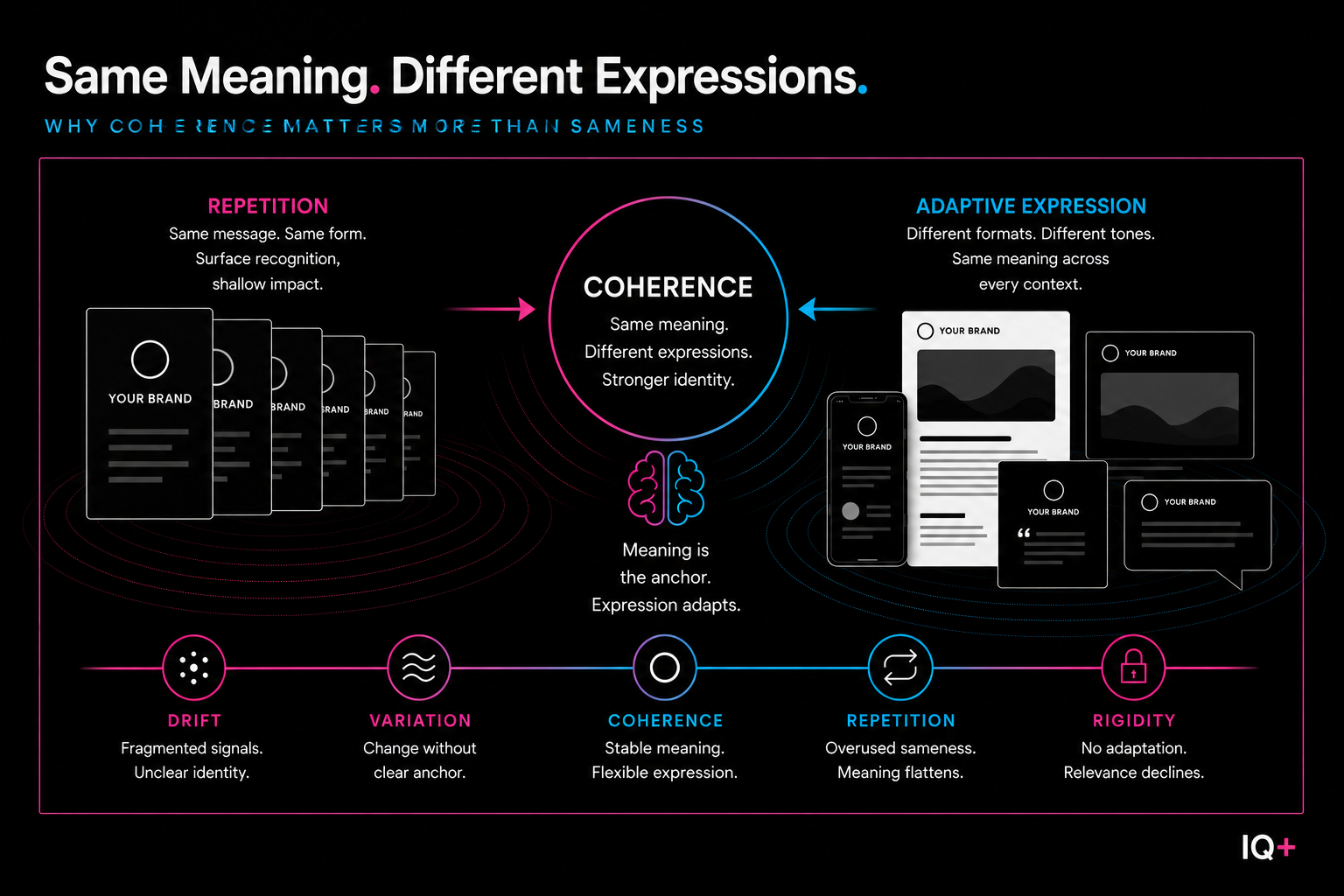
Real brand consistency is not achieved by repeating the same words, visuals, or messages in every setting. It is achieved by preserving the same underlying meaning across varied expressions. The identity remains stable, but the expression adapts according to context, channel, audience state, and purpose.
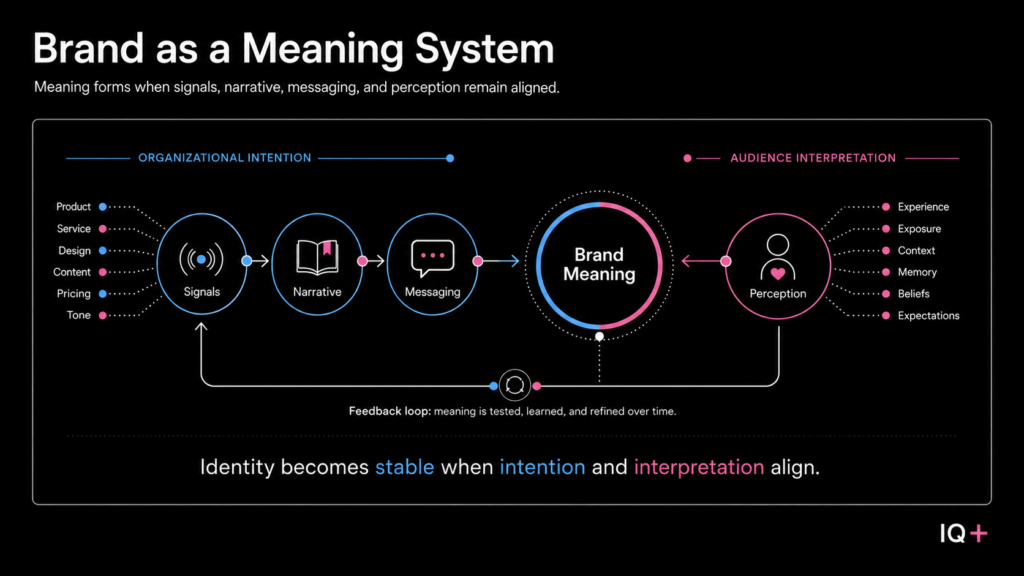
That distinction matters because brands exist across many different formats and moments. A homepage, article, service page, social post, visual system, support interaction, and product decision all produce signals. Each one shapes perception. Each one contributes to what the brand comes to mean.
If consistency is reduced to repetition, the brand may become uniform without becoming meaningful. It may look controlled while failing to produce a stable interpretation.
A consistent brand does not say the same thing everywhere.
It preserves the same meaning everywhere, even when the form changes.
Repetition Is Not Coherence
Repetition is a surface behaviour.
It repeats a message, visual cue, phrase, structure, or pattern across multiple expressions. Used well, repetition is useful. It can make communication more familiar. It can create memory. It can reduce fragmentation. It can help an audience recognize that one expression belongs to the same brand as another.
So the problem is not repetition itself.
The problem begins when repetition is mistaken for brand consistency.
Coherence is deeper than sameness. It exists when different expressions produce recognizable meaning together. The words may change. The format may shift. The level of detail may vary. The audience context may be different. But the brand still feels like the same identity because the underlying meaning remains aligned.
This is why repeated messaging can still fail.
A brand may use the same tagline across every channel, but if the experience contradicts it, the repetition does not create coherence. A brand may apply the same visual style to every asset, but if the tone, promise, and behaviour are inconsistent, the design does not stabilize meaning. A brand may repeat its stated values, but if those values are not visible in decisions, service, or experience, the repetition becomes decorative.
Sameness can create recognition without trust.
That is the part worth slowing down. Recognition tells the audience, “I have seen this before.” Trust requires something more. It requires the repeated signals to hold together across experience, behaviour, language, design, and expectation.
A repeated message is only one signal.
Audiences do not interpret messages in isolation. They notice patterns. They compare what a brand says with how it behaves. They notice what is emphasized, what is avoided, what stays stable, and what changes over time.
So repetition may help a brand become identifiable, but coherence is what helps it become meaningful.
The task is not to make every expression look and sound the same.
The task is to make different expressions point back to the same underlying meaning.
Meaning Before Expression
Brand consistency begins before expression.
Before deciding which words to repeat, which visuals to use, or which tone to maintain, a brand needs to understand what meaning it is trying to preserve. Without that clarity, consistency becomes a surface exercise. The design may look controlled. The messaging may sound aligned. The tone may stay within familiar boundaries.
But the identity underneath can still remain unstable.
This is why the central question should not be: What should we say everywhere?
The stronger question is: What meaning must remain recognizable across everything we say, show, publish, and do?
That question changes the work. It shifts consistency away from duplication and toward interpretation. The goal is no longer to copy the same expression into every context. The goal is to make sure different expressions continue to produce the same underlying recognition.
A homepage may explain the brand at a high level. A service page may make that meaning more practical. A brief post may express it in compressed form. A support interaction may translate it into behaviour. A visual system may carry it through rhythm, contrast, spacing, and restraint.
These expressions do not need to be identical.
They need to feel connected.
This is the difference between wording and meaning. Wording is the phrase used to express an idea. Meaning is what that idea allows an audience to understand, expect, or trust.
Wording can change while meaning remains stable.
But when meaning is unclear, repeating the wording does not solve the problem. It only makes the gap more visible. The brand may sound repetitive while still feeling unclear, because the expression is being controlled more carefully than the meaning behind it.
That is why consistency has to begin with meaning. Once the meaning is clear, expression can adapt without becoming disconnected. But when meaning is weak, repetition becomes a substitute for clarity — and the more often the brand repeats itself, the more obvious the weakness becomes.
The Risk of Mechanical Repetition
Mechanical repetition creates its own risks for brand consistency.
At first, it can look disciplined. The same phrase appears in every message. The same claim anchors every page. The same visual structure is applied to every asset. The surface looks aligned, and alignment can easily be mistaken for consistency.
But when repetition becomes too rigid, it begins to flatten the brand.
The brand starts to sound the same regardless of what the audience needs, where the communication appears, or what the moment requires. A complex topic receives the same surface message as a simple one. A hesitant audience receives the same emphasis as a decided one. A trust-building moment is treated like a promotional moment.
The form stays consistent, but the expression becomes less responsive.
This is where a brand can develop surface consistency while meaning begins to drift.
That drift can be difficult to notice because the visible system still looks managed. The colours remain stable. The message is repeated. The tone stays controlled. The templates are followed. Nothing appears obviously broken.
But underneath the surface, the repeated expression may no longer match the experience. The audience may still recognize the brand while becoming less clear about what it actually represents. The brand may look coherent while becoming less meaningful.
This is the danger of protecting sameness too strongly. A rigid system can prevent the brand from sounding “off,” but it can just as easily prevent it from responding intelligently to context.
That is why repetition should be treated as a tool, not a definition of consistency.
Used carefully, repetition reinforces recognition. Used mechanically, it can become a substitute for interpretation. It protects the surface while allowing the meaning underneath to weaken.
Adaptive Consistency
Variation does not automatically create inconsistency.
This is an important point because consistency is often protected too narrowly. If every change in tone, format, depth, or emphasis is treated as a threat, the brand becomes difficult to use in real conditions. It may remain controlled, but it also becomes rigid.
A brand can adapt its expression while preserving the same underlying meaning. In fact, it often has to.
Different contexts require different forms of communication. A detailed analytical article cannot carry meaning in the same way as a landing page. A short post cannot do the same work as a long essay. A service interaction cannot sound like a brand manifesto. A search result, a visual asset, a support reply, and a strategic page each place different demands on expression.
The question is not whether they all sound identical.
The question is whether they still produce coherent recognition.
Adaptive brand consistency allows expression to change without allowing meaning to drift. It makes room for variation while protecting the identity underneath. The core meaning remains stable. The essential signals remain aligned. But the form changes according to the environment it enters.
This requires a clear distinction between what must remain stable and what is allowed to vary.
A detailed article may express authority through careful explanation and deliberate structure. A landing page may express the same authority through clarity and compression. A brief post may express it through a sharper observation. A client conversation may express it through restraint, listening, and diagnostic precision.
These are different expressions.
But they can still belong to the same brand if they preserve the same underlying meaning.
This is especially important when a brand operates across contexts with different structural demands. Search rewards clarity and intent alignment. Long-form content rewards depth and argument. Service interactions reward responsiveness and trust. Visual identity rewards recognition and continuity. Forcing the same expression into each environment may produce a brand that sounds consistent, but communicates poorly.
Consistency therefore requires translation. It carries the same meaning into forms appropriate to each context, rather than imposing the same form everywhere.
Yale’s guidance on consistency makes a similar distinction: consistency does not require every touchpoint to look identical. The objective is to create familiar patterns that remain connected across different contexts and interactions.
A consistent brand is not frozen.
It remains interpretable across change.
Building Guardrails for Meaning
Brand consistency needs guardrails.
Without them, variation can easily become drift. Different teams, channels, formats, or moments begin expressing the brand in slightly different ways. At first, the differences may seem small. A phrase changes. A visual choice shifts. A message becomes more generic. A tone becomes more reactive. Nothing looks serious enough to correct.
But over time, those small changes can pull meaning apart.
This is why guardrails matter. Their purpose is not to make every expression identical — a good guardrail system does not freeze the brand. It protects the meaning that must remain stable while giving expression enough room to adapt.
The first guardrail is core meaning.
This is the underlying idea the audience should be able to recognize across all expressions. It is not the tagline. It is not the slogan. It is not a preferred phrase. It is the interpretive constant that should survive changes in format, tone, channel, or level of detail.
When core meaning is unclear, teams often default to repetition. Not because repetition is the strongest choice, but because it is the safest visible choice. If there is no deeper meaning to hold onto, repeating the same words and visuals becomes a substitute for knowing what must actually remain stable.
The second guardrail is the set of non-negotiable signals.
Some narrative themes, visual relationships, tonal boundaries, and behavioural expectations carry identity more heavily than others. They are not just stylistic preferences. They are the cues through which the audience recognizes the brand as itself.
The third guardrail is permission to vary.
This part is easy to overlook. A brand system should not only define what must stay fixed. It should also define what can change: depth, format, examples, emphasis, structure, level of explanation, and channel-specific expression.
Without that permission, people default to sameness because they cannot tell the difference between a necessary anchor and an adaptable surface.
The fourth guardrail is context logic.
Expression should shift depending on audience state, channel constraints, and communicative purpose. The same brand may need to be more explanatory in one environment and more compressed in another. It may need to build trust in one moment and clarify a decision in another.
Both expressions can still be consistent if they are anchored to the same meaning.
The fifth guardrail is drift indicators.
Drift is rarely sudden. It usually appears gradually: language that sounds less connected to the core meaning, visual choices driven more by trend than identity, messages that become generic, or repeated claims that no longer match the experience being delivered.
Guardrails are useful because they make that drift easier to notice before it becomes a perception problem.
Together, these layers create a brand system that is neither rigid nor loose. It can adapt without becoming fragmented. It can repeat without becoming mechanical. It can preserve meaning without forcing every expression into the same shape.
That is the real purpose of consistency: not message control, but meaning control.
The Consistency Spectrum
The distinction between brand consistency and repetition becomes easier to see when we place it on a spectrum.
At one end is drift.
This is where expression becomes so varied, unguided, or reactive that the brand becomes difficult to recognize. Different encounters produce different impressions. The signals do not accumulate into a stable identity. The audience may see activity, but they cannot easily understand what holds it together.
Near drift is uncontrolled variation.
Variation itself is not the problem. As we have already seen, brands need variation because different contexts require different expressions. The problem is variation without a stable centre. When expression changes without being anchored to core meaning, the brand starts to wander.
The desired zone is coherence.
This is where the brand adapts across context while preserving recognizable meaning. The wording may change. The tone may shift. The format may vary. The level of detail may expand or contract. But the identity remains interpretable because the underlying meaning stays stable.
This is the strongest position.
But what matters is where repetition sits on the spectrum.
Repetition does not sit before coherence. It sits after it.
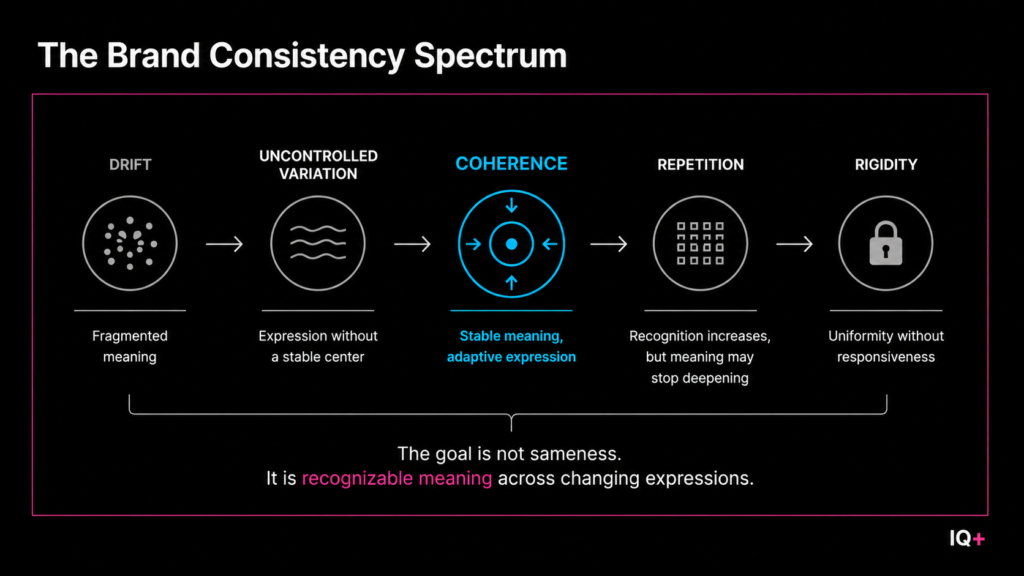
That placement is important. Repetition can support recognition, but when it becomes excessive, it does not move the brand closer to meaning. It can move the brand away from it. The brand becomes easier to identify, but not necessarily easier to understand. Sameness accumulates, but meaning does not deepen.
Beyond repetition is rigidity.
This is where the system becomes so fixed that it cannot adapt to context at all. The brand protects uniformity at the cost of relevance. It sounds controlled, but not responsive. It maintains the surface while losing interpretive strength.
So the goal is not to eliminate repetition.
Brands need recurring signals. They need recognizable patterns. They need stable cues that an audience can encounter repeatedly and remember over time. But those repeated elements should serve coherence. They should not replace it.
The strongest brand position is not drift, variation, repetition, or rigidity.
It is coherence: stable enough to preserve meaning, flexible enough to remain contextually intelligent.
Conclusion — Coherence Over Sameness
What separates a brand governed by coherence from one managed through repetition?
The difference rarely appears in a single message, page, or visual. One expression may look consistent on its own. The real test appears over time, across conditions, and across the different ways an audience encounters the brand.
Can the audience recognize the same identity in a brief post, a detailed article, a service interaction, a visual system, and a product decision?
That is where brand consistency becomes more than sameness.
A coherent brand does not produce identical expressions everywhere. It produces recognizable meaning. That meaning survives changes in format, channel, tone, and depth because it is anchored in something more stable than wording.
Repetition can support that stability, but it cannot create it on its own.
When a brand relies on repetition to produce coherence, it mistakes a visible cue for the deeper structure. Recognition may accumulate, but meaning does not necessarily deepen with it. The audience may remember the phrase, colour, or pattern, while still remaining unclear about what the brand represents.
The risk becomes sharper when the repeated expression no longer matches the experience. The surface remains stable, but the meaning underneath begins to drift. And because the brand still looks consistent, the gap can be harder to notice.
This is why brand consistency has to be understood as meaning preservation, not message duplication.
The work is not to say the same thing everywhere.
It is to preserve the same understanding everywhere — and to know the difference between the two.
If you enjoyed this analysis and would like to continue exploring these ideas, subscribe to receive new AnalytIQs+ essays and new publication updates by email.