When Publishing Outruns Maintenance: What Storyblok Reveals About Content Debt
Most content debt does not begin with obviously bad content.
A campaign needs a landing page. An event needs a registration page. A product release needs an announcement. Each publishing decision has a purpose, an owner, and an immediate deadline. At the moment of creation, the content may be accurate, useful, and strategically justified.
The problem appears later. The campaign ends, the event passes, the product changes, and the employee responsible for the page moves to another role. The content remains online, but the conditions that once justified it no longer exist.
When I look at content debt, I do not see only a collection of outdated pages. I see the accumulated consequence of publishing without an equally reliable process for reassessing what has already been published.
Storyblok encountered this problem across a marketing website that had grown through years of campaigns, events, product releases, and distributed publishing. The company eventually counted 4,546 stories in its content-management system, 4,302 of them published, alongside 201 active components in its block library. Ownership had become unclear, outdated information remained accessible, and the growing content estate was creating editorial and technical overhead.
Storyblok responded with a structured initiative called Operation Content Debt. It removed 691 pages and reduced the size of its content estate. But as we move through the case, the more important correction is not the deletion itself. It is the governance system introduced afterward: named ownership, retirement policies, automated triggers, and recurring review cycles.
The case gives us a useful distinction. Publishing is only one stage of a content system. Creation explains how a page begins. Governance determines whether it should continue to exist.
How Useful Content Becomes Content Debt
Content debt is often described as outdated, duplicated, or unmanaged material that becomes harder to maintain over time. That description is accurate, but it can make the problem sound as though it begins with poor editorial judgment. Storyblok’s case suggests something more ordinary.
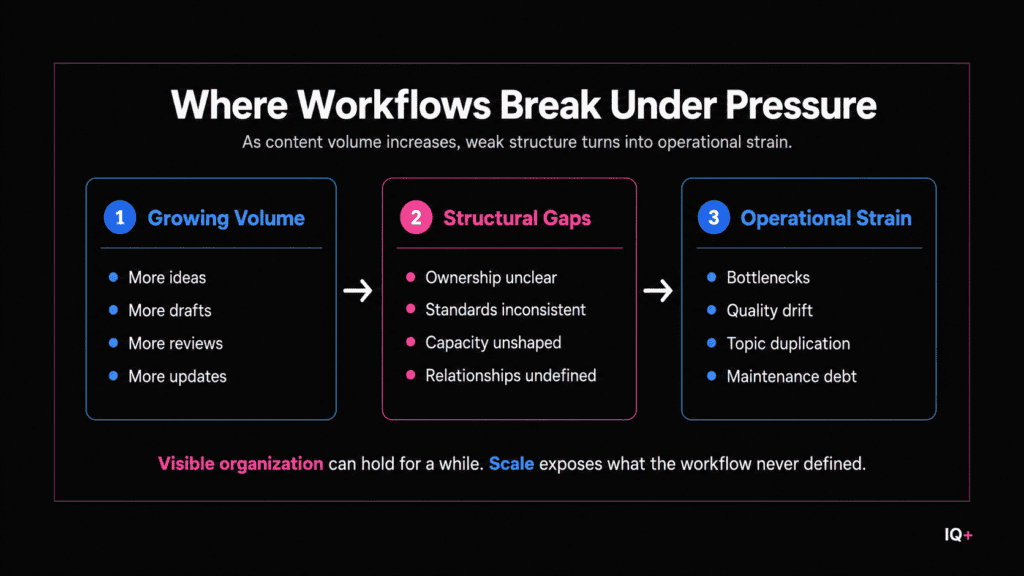
The company’s content estate grew through recurring organizational behaviour. Campaigns produced new assets. Events produced temporary pages. Product development produced announcements and feature pages. Different departments published according to their own needs, and teams and responsibilities changed over time. None of these actions automatically represents a failure.
What we need to notice is the asymmetry between creation and reassessment. Publishing continued; review did not. Storyblok had a dependable reason and process for adding content, but no equally dependable mechanism for deciding when that content should be updated, consolidated, or removed.
This distinction matters because a page does not become debt simply because it is old. Some older pages remain accurate, useful, and strategically important. Others lose their value quickly. A temporary event page may become irrelevant within days, while an evergreen product guide may remain valuable for years. The issue is not age. It is unmanaged continuation.
I would define the problem this way: a page becomes a source of content debt when its continued existence is no longer being actively evaluated. Its owner is unclear. Its purpose is assumed rather than confirmed. Its information may be outdated, but no one is accountable for reviewing it. It remains online because publication was treated as the final decision.
That is how individually reasonable pages accumulate into an unhealthy structure.
What Storyblok Found Inside Its Content System
By the time Storyblok began its review, the company reported 4,546 total stories in its CMS, 4,302 of them published, and 201 active components in its block library. Alongside those figures, it reported unclear ownership across departments, outdated material appearing through search and AI-generated results, and increased editorial and technical overhead.
The volume itself was not the only problem. We should be careful not to treat a large website as an unhealthy website by default; thousands of pages may be justified when they serve distinct audiences and remain accurate, findable, and maintained. Storyblok’s difficulty was that the size of the estate had become increasingly disconnected from reliable ownership and current purpose.
The symptoms appeared across several layers. Outdated pages could still surface through search systems and AI-generated responses, presenting information that no longer reflected the company accurately. Internal teams and users had to navigate material that should have been refreshed, merged, or retired. The component library had also grown, contributing to build, indexing, and deployment overhead.
The website contained more information, but the environment supporting that information had become less dependable. This is one of the more consequential effects of content debt: an organization can keep expanding its publishing output while gradually weakening the reliability of the whole content system. When we measure publishing mainly through output, more content looks like progress. Without maintenance, it can produce more uncertainty rather than more usable knowledge.
Why the Problem Remained Unresolved
Content maintenance usually competes with work that appears more immediate. A new campaign has a launch date. A product release has executive attention. A sales request has a visible business purpose. Publishing new material creates an observable output.
Maintenance operates differently. Reviewing an old page may prevent a future problem without producing an obvious new asset. Consolidating five overlapping pages into one can improve the system while making the content count appear smaller. Retiring a page can look like subtractive work, even when it reduces confusion and technical burden.
Publishing appears productive. Maintenance appears retrospective. That difference, I think, explains much of why content debt goes unresolved for so long: the work that creates the problem is visible and rewarded, while the work that prevents it is quieter and easier to postpone.
Storyblok addressed this tension by naming the work Operation Content Debt rather than treating it as an informal cleanup. The company defined the initiative, assigned responsibility, and gave it organizational visibility. That framing mattered because the problem could no longer be handled as a collection of isolated page issues. It was an operating condition created by the relationship between publishing, ownership, and time.
Once we recognize the problem at that level, the response changes as well. The central content team does not simply decide which pages to delete. The organization has to coordinate decisions across the teams that created, used, or depended on those pages.
How the Content Audit Separated Removal from Optimization
Storyblok created a master inventory of its website content and divided the review according to team ownership. Each responsible team assigned one of three decisions to its URLs: remove, update, or ready. The review drew on quantitative signals such as pageviews, time on page, engagement, and conversion indicators where available, and it also weighed relevance, strategic purpose, and ownership.
The data created a starting point, but it did not make the final decision, and this is the point at which I would separate measurement from interpretation. A low-traffic page might have little value. It might also serve a small but strategically important audience, or be useful and simply difficult to find. A high-traffic page might appear successful while presenting outdated product information.
A content audit therefore cannot be reduced to a spreadsheet calculation. The evidence identifies conditions that deserve attention, but editorial interpretation still has to answer the larger questions. Is the page accurate? Does it serve a current audience need? Does it support an active strategic objective? Should it be improved, consolidated, retained, or retired? And is weak performance evidence of low value, or evidence of poor findability?
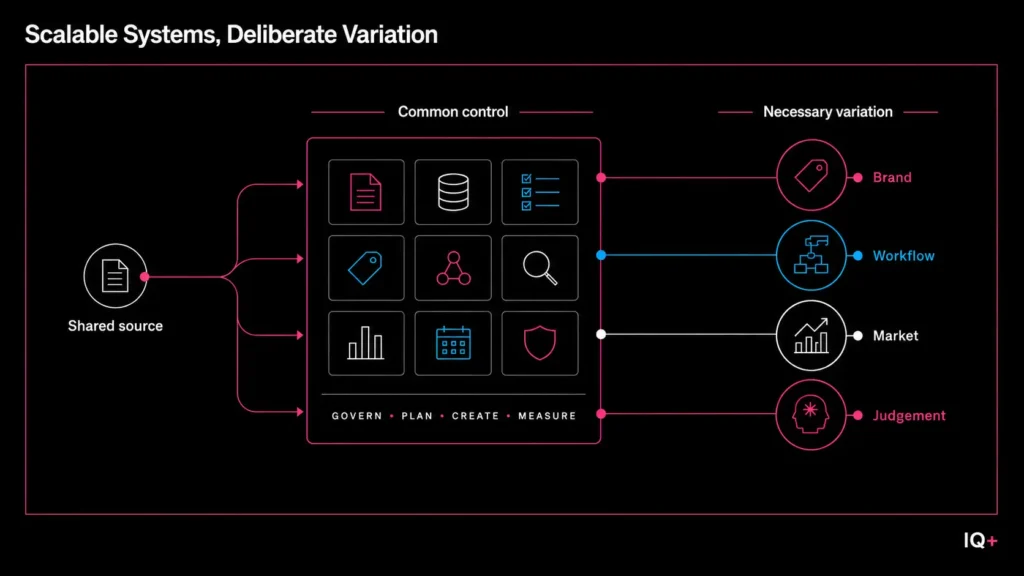
Storyblok balanced centralized governance with distributed subject-matter knowledge. The central content team established the method, while the departments closest to the material made the final decisions. We can see why that balance matters. A purely centralized audit may lack the context needed to evaluate specialized pages. A fully decentralized audit may reproduce the same inconsistencies that allowed the problem to accumulate. Storyblok used a shared decision system without pretending that every page could be judged through one metric.
That balance becomes a broader content-operations question at scale: which repeated decisions should move under common system control, and which still need to vary because context changes them?
Removal Is an Architectural Process
Storyblok removed 569 pages during the first phase of the initiative. Outdated event pages, webinar pages, and product announcements were the largest sources of content debt, accounting for 71% of those first-stage removals.
The company did not simply delete the pages and leave the surrounding structure unchanged. Storyblok reported that it implemented redirects where appropriate, created custom 404 pages for specific content types, reviewed internal references, removed links to retired material, checked for broken links, and took steps to prevent crawl errors and orphaned references.
This reveals something we often overlook when discussing content pruning. A page is rarely an isolated object. It may receive internal links, appear in navigation, support another page’s argument, rank for search terms, or act as a route into a broader section of the website. Removing it changes those relationships.
I would therefore treat content retirement as an architectural process rather than a deletion task. The decision is not only whether the page should disappear; we also have to determine what happens to the routes, links, references, and expectations connected to it. Content pruning requires examining what depends on a page and what should happen to the users or systems that still encounter its URL.
What Changed After 691 Pages Were Removed
After the first removal phase, Storyblok examined the remaining pages against a higher threshold. A page had to demonstrate at least one of three conditions: measurable performance, a clear audience need, or support for a strategic objective. The company removed another 122 pages, bringing the total to 691, and identified 101 pages requiring optimization. Fifteen were marked high priority, while the remaining 86 were incorporated into team workflows with assigned owners and timelines.
Storyblok reported several operational changes:
- total CMS stories fell from 4,546 to 3,988, a 12% reduction;
- published stories fell from 4,302 to 3,817, an 11% reduction;
- active library components fell from 201 to 194;
- website deployment files fell from 3,168 to 2,876;
- maximum deployment time fell from 18 minutes to 16 minutes;
- the Algolia index-rebuild time fell from 36 minutes and 14 seconds to 30 minutes and 41 seconds.
The page-removal total and the story counts are reported separately and do not reconcile exactly. Storyblok’s account does not explain the gap, so I treat them as distinct measurements rather than as one result expressed two ways.
The Algolia figure needs careful handling. Storyblok sometimes summarized the outcome as “15% faster indexing,” but the detailed measurement refers specifically to the company’s Algolia index rebuild. We should not read it as evidence that Google indexed Storyblok’s website 15% faster.
We also cannot claim that deleting pages alone caused every technical improvement. The initiative included several changes at once, and Storyblok’s reporting is a first-party account rather than an independently audited study. It establishes no direct ranking, revenue, or conversion gains.
Even with those qualifications, the figures are useful. They show that reducing unnecessary content affected more than editorial order; it also reduced part of the technical workload surrounding deployment and internal search infrastructure. The case does not prove that fewer pages are always better. It shows that unmanaged content creates costs beyond the page itself.
Why Cleanup Alone Was Not Enough
The content audit reduced the accumulated burden, but it did not eliminate the behaviour that created it. Storyblok would continue publishing. Campaigns would still require landing pages. Events would still produce temporary assets. Product teams would continue announcing features. Employees would continue changing roles. Without a permanent correction, the content estate could begin growing under the same conditions again.
This is the central limitation of one-time cleanup. An audit can identify the current state of a website and help teams remove, update, or consolidate material. But it does not establish who will review new pages six months later. It does not define when an event page should expire. It does not determine who becomes responsible when the original author leaves.
We can therefore separate the two functions clearly. The audit addresses content debt that has already accumulated. Content governance changes the operating conditions that would otherwise allow it to return.
The sequence becomes clearer when we separate the work that reduces existing content debt from the governance that prevents it from accumulating again.

Storyblok’s most important change was not a smaller page count. It was the introduction of a continuing management structure around ownership, retirement, automation, and review.
How Storyblok Turned Maintenance into Governance
Storyblok created a content-ownership database in Notion and assigned every content category to a named individual rather than to a department alone.
That distinction is more consequential than it may appear. A department cannot personally notice that a page has become inaccurate, and it does not carry accountability the way an individual does. When responsibility remains collective and abstract, each person can reasonably assume that someone else will act. Named ownership identifies who must respond when content becomes outdated, inaccurate, or unnecessary. Storyblok planned to review the ownership database every six months so that accountability could change as roles changed.
The company also introduced defined retirement periods for specific content types. Global event and product-feature pages could retire one year after publication, while field and partner event pages could retire one week after the event. Other pages would be reviewed according to relevance, accuracy, and performance.
To my reading, this is the strongest part of the case because retirement changed from an exceptional decision into an expected lifecycle stage. Some pages are temporary by design, and a mature approach to content lifecycle management recognizes that before publication rather than discovering it years later during a crisis cleanup.
Storyblok also created automated triggers for conditions that could indicate deterioration: event and feature pages reaching their retirement dates, blog titles containing outdated years, articles receiving no visits for six months, core pages not updated for more than a year, broken links, missing metadata, duplicate metadata, and new titles or URLs resembling existing content.
The automation did not decide what should happen. It surfaced conditions requiring review, and teams still had to interpret whether the correct action was to update, consolidate, retain, or remove the page. We should preserve that distinction. Automation can reduce the chance that deterioration remains invisible; it cannot determine strategic relevance, audience need, or editorial value on its own.
Storyblok then established several review cadences: quarterly reviews of accumulated trigger notifications, biannual traditional and AI-search audits, annual strategic assessments, and event-driven audits following launches, rebrands, or major announcements. Maintenance was no longer something the organization would remember to do when the website became visibly difficult to manage. It became part of the operating rhythm.
What McGill Adds to the Case
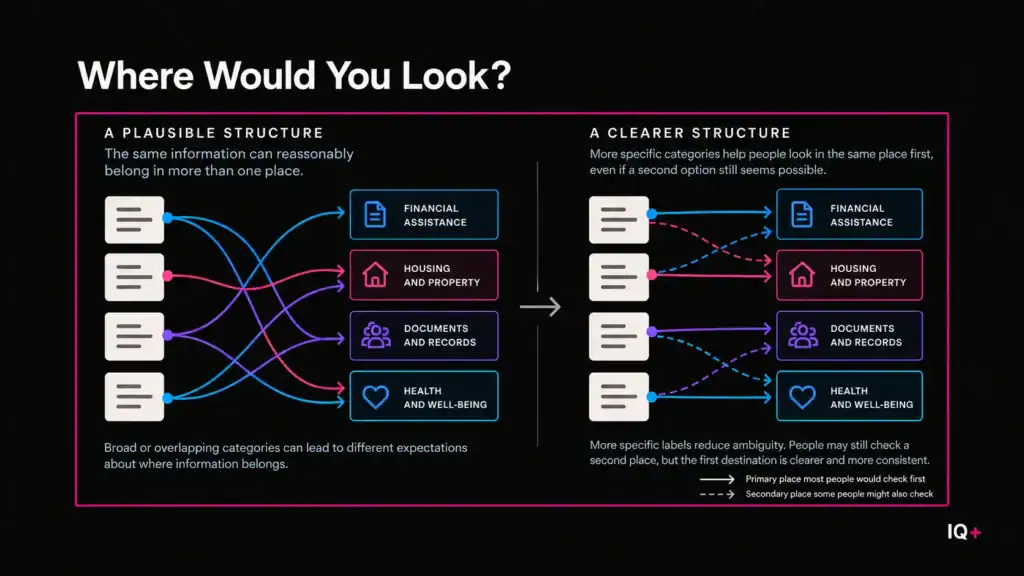
Storyblok shows one side of content architecture: deciding what should continue to exist. McGill University’s IT Services redesign shows another: organizing the remaining information around how users actually seek help.
McGill found that visitors were not using its service-category navigation effectively. Important sidebar material was being overlooked, and the site’s structure did not adequately reflect how non-technical users looked for assistance. The redesign incorporated audience focus groups, analytics, a content audit, usability testing, and continuing evaluation.
McGill replaced some internally oriented labels with clearer task-based language, including “Get help” and “Make a request.” It reduced the number of top-level navigation items from 10 to 7, combined or decommissioned outdated sections, and gave greater prominence to popular pages and help resources. After the broader redesign, McGill reported a 20% reduction in bounce rate and an 18% increase in pageviews. These are first-party results, and we should not attribute them to navigation reduction alone, because the project also included visual, homepage, usability, and content-strategy work.
The comparison helps us separate two responsibilities that are often grouped together. Storyblok’s problem was accumulation without retirement. McGill’s problem was organization around internal categories rather than user behaviour. I keep those responsibilities distinct because a website can fail either one independently. It may hold accurate, maintained content that remains difficult to navigate, or offer clear navigation while carrying large amounts of stale or duplicated information.
Content architecture must therefore determine both what should continue to exist and how the remaining content should be organized.
A Content System Must Manage Continuation
Both cases show these decisions being made in practice. To place them within an established methodology, we can turn to Nielsen Norman Group’s distinction between a content inventory and a content audit. An inventory records what exists: titles, URLs, formats, owners, dates, and metadata. An audit evaluates that material and determines whether it should be kept, updated, or removed. The methodology also emphasizes ownership, stakeholder participation, prioritization, and the combination of quantitative evidence with qualitative judgment.
Storyblok’s case shows what happens when that work becomes part of a broader lifecycle rather than an occasional exercise. Every page should eventually be able to answer a consistent set of questions: why it exists, who is responsible for it, which audience it serves, and how its performance will be evaluated. It should also be clear when the page will be reviewed, under what conditions it should be updated or consolidated, when it should be removed, and which links, routes, and references depend on it.
These are not questions to answer only during a large website content audit. They should shape the content system before debt accumulates.
We often treat publishing as the point at which content becomes complete. Storyblok’s experience supports a better interpretation: publication is the beginning of a management obligation. Creation determines why the content enters the system. Continuation determines whether it still belongs there.
Publication Is Not Permanence
Storyblok did not need to stop publishing. It needed to stop treating publication as the final state of content.
The company’s problem developed because immediate publishing needs were repeatedly met while long-term maintenance remained optional. The content audit reduced the visible burden by removing 691 pages and identifying valuable material for optimization. But when we look at the full sequence, the durable correction came afterward. Named ownership established accountability. Retirement policies recognized that some pages were temporary. Automated triggers surfaced deterioration. Recurring audits made reassessment part of normal operations.
The mechanism is clear enough to state plainly. Content debt was the accumulated problem. The content audit reduced the burden. Content governance changed the system that produced it.
Fewer pages are not automatically better, and more pages are not automatically harmful. The question that matters is whether every page continues to have a defensible purpose, a responsible owner, and a defined place within the larger structure. Without those conditions, publishing volume gradually becomes content debt.
If you enjoyed this analysis and would like to continue exploring these ideas, subscribe to receive new AnalytIQs+ essays and new publication updates by email.